
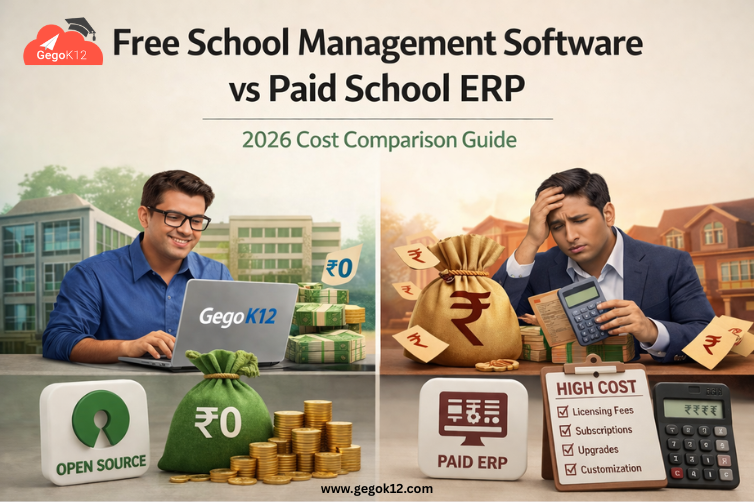
School administrators face a critical decision when selecting management software: invest ₹50,000-500,000+ annually in proprietary paid systems, or implement free open-source solutions offering equivalent functionality without recurring fees. This comparison has become more nuanced in 2026 as free platforms have matured dramatically, now delivering enterprise-grade capabilities that previously required expensive commercial licenses. This comprehensive analysis examines free school management software vs paid school ERP across every decision criterion that matters – features, total cost of ownership, support quality, implementation complexity, data security, and long-term viability. After evaluating both options thoroughly, we’ll provide the data-driven framework helping schools make confident, strategic technology investments aligned with institutional priorities and budget realities.
Understanding the True Cost Difference
Paid School ERP: The Complete Price Reality
Upfront Licensing: ₹30,000-150,000 initial license purchase based on student enrollment
Annual Subscriptions: ₹50,000-300,000 yearly renewal for continued access
Per-Student Charges: ₹200-800 per student annually in some pricing models
Implementation Fees: ₹50,000-200,000 for initial setup and configuration
Training Costs: ₹20,000-80,000 for staff training programs
Customization Charges: ₹50,000-300,000 for institution-specific modifications
Support Contracts: ₹30,000-100,000 annually for technical support beyond basic tiers
Upgrade Fees: ₹20,000-100,000 for major version upgrades every 2-3 years
Total 5-Year Cost for 500-Student School: ₹4,50,000 – ₹15,00,000+
Free Open-Source Software: True Cost Analysis
GegoK12’s MIT-licensed platform operates under fundamentally different economics:
Software License: ₹0 – Complete platform access without licensing costs
Annual Renewals: ₹0 – No subscription fees ever
Per-Student Charges: ₹0 – Unlimited users without per-seat pricing
Source Code Access: ₹0 – Full code access for unlimited customization
Community Updates: ₹0 – Regular platform improvements without upgrade fees
Actual Costs for Free Platforms: Hosting (Self-Hosted): ₹10,000-30,000 annually for server/cloud infrastructure
Optional Professional Support: ₹30,000-80,000 annually if choosing guided implementation
Initial Setup Time: Internal IT staff time or one-time implementation service
Training: Free video tutorials + optional paid training
Total 5-Year Cost for 500-Student School: ₹50,000 – ₹4,00,000 (90-95% savings vs paid options)
Feature Comparison: Free vs Paid
Core Administrative Features
Student Information Management
- Paid Systems: ✅ Comprehensive
- Free (GegoK12): ✅ Comprehensive – Complete student database with unlimited records
Attendance Tracking
- Paid Systems: ✅ Digital marking with parent notifications
- Free (GegoK12): ✅ Identical functionality – Digital + SMS/app alerts
Fee Management
- Paid Systems: ✅ Online payment integration
- Free (GegoK12): ✅ Full payment gateway integration with automated receipting
Examination Management
- Paid Systems: ✅ Question banks, automated grading
- Free (GegoK12): ✅ Complete exam automation with result processing
Timetable Generation
- Paid Systems: ✅ Automated scheduling
- Free (GegoK12): ✅ Intelligent timetable generation with conflict resolution
Report Cards
- Paid Systems: ✅ Automated generation
- Free (GegoK12): ✅ Template-based automation with digital distribution
Parent Communication
- Paid Systems: ✅ Mobile apps and portals
- Free (GegoK12): ✅ Dedicated parent apps with push notifications
Library Management
- Paid Systems: ✅ Barcode integration
- Free (GegoK12): ✅ Complete cataloging with barcode/RFID support
Transport Management
- Paid Systems: ✅ GPS tracking
- Free (GegoK12): ✅ Full GPS integration with parent tracking apps
HR and Payroll
- Paid Systems: ✅ Employee management
- Free (GegoK12): ✅ Complete HR workflows with payroll automation
Verdict: Feature parity is 100%. Free platforms deliver identical capabilities without functional compromises.
Critical Decision Factors Beyond Features
Data Ownership and Control
Paid Systems:
- Data resides on vendor servers
- Access dependent on continued subscription
- Export limitations if switching platforms
- Vendor controls access and retention policies
Free Open-Source:
- Complete institutional data ownership
- Self-hosted deployment keeps data on-premise
- Unrestricted data export in standard formats
- School maintains permanent access regardless of vendor relationship
For Indian schools under data protection regulations or government mandates requiring data sovereignty, free open-source platforms provide compliance certainty impossible with cloud-only paid systems.
Vendor Lock-In Risk
Paid Systems: Switching costs after 2-3 years approach original implementation investment. Proprietary data formats, custom integrations, staff familiarity with specific interfaces, and migration complexity create economic barriers trapping schools in escalating subscription relationships.
Free Open-Source: GegoK12’s standard data formats, API access, and migration tools ensure institutional freedom. Schools change providers at any time without vendor permission or punitive switching costs.
Customization Flexibility
Paid Systems: Customization requires expensive professional services. Minor changes cost ₹20,000-50,000. Significant modifications require ₹100,000-300,000 investments with vendor approval. Customizations may break during vendor upgrades, requiring paid reconfiguration.
Free Open-Source: Complete source code access enables unlimited customization without vendor involvement. Schools with technical capacity modify anything. Changes persist across platform updates through standard version control. Community shares customizations reducing duplicate development effort.
Support Quality and Availability
Common Misconception: “Paid systems provide better support.”
Reality Check:
- Paid Support: Often tiered with fastest response only at premium pricing levels
- Free Community Support: Active forums, documentation, peer assistance
- Paid Professional Support for Free Platforms: GegoK12 offers optional paid support matching commercial quality
Schools can choose support levels matching needs rather than accepting vendor-dictated support tiers bundled with software licenses.
Long-Term Platform Viability
Paid Systems: Dependent on vendor financial health. Vendors acquired by competitors may discontinue products, force platform changes, or dramatically increase pricing. Schools become hostages to vendor business decisions.
Free Open-Source: Platform viability independent of single vendor. If original developers discontinue projects, communities maintain and fork codebases ensuring continuity. Schools never face forced migrations due to vendor business failures.
Common Objections to Free Software: Reality vs Myth
“Free software must lack features compared to paid systems.”
Myth. Modern open-source school platforms evolved over 10-15 years incorporating every feature commercial systems offer. GegoK12’s 23+ modules cover 100% of school operational needs without functional gaps.
“We’ll have no support with free software.”
Myth. GegoK12 provides comprehensive documentation, video tutorials, community forums, and optional professional support services. Support quality equals or exceeds many paid vendors’ basic support tiers.
“Implementation will be too complex for our IT staff.”
Myth. Modern platforms provide installation automation, configuration wizards, and migration tools simplifying deployment. Most schools successfully implement within 4-8 weeks with existing IT resources.
“Free software won’t integrate with other systems.”
Myth. Open-source platforms typically offer superior integration through well-documented APIs and standard protocols. Proprietary systems often limit integration protecting vendor ecosystems.
“Security won’t be as strong with free platforms.”
Myth. Open-source security is transparent – entire global community reviews code identifying vulnerabilities quickly. Proprietary systems hide security through obscurity, often containing unknown vulnerabilities until exploited.
The Hidden Costs Paid Systems Don’t Advertise
Annual Price Increases
Paid vendors typically increase subscription costs 8-15% annually. That ₹80,000 annual subscription becomes ₹130,000-180,000 by year five. Free platforms never raise licensing costs because none exist.
Forced Upgrade Cycles
Vendors discontinue older versions forcing costly upgrades every 3-4 years. “Legacy” versions lose security updates creating compliance risks. Free platforms update continuously without forced migration costs.
Per-User Pricing Traps
As enrollment grows, per-student licensing multiplies costs automatically. Adding 100 students may increase annual costs ₹20,000-80,000. Free platforms scale without cost increases.
Module Upselling
Basic packages exclude essential features – advanced reporting, mobile apps, API access – forcing additional module purchases. Free platforms include comprehensive functionality upfront.
When Paid Systems Make Sense (The 5% Use Case)
Very Large Districts (5,000+ students across multiple campuses) with complex regulatory requirements might benefit from enterprise paid systems offering:
- Dedicated account management teams
- 24/7 guaranteed support SLAs
- Regulatory compliance certification assistance
- Multi-district coordination features
However, even large institutions increasingly choose open-source platforms, contributing to development for needed features rather than paying premium licensing fees.
Implementation Comparison
Paid System Implementation
Timeline: 8-16 weeks
Vendor Dependency: Complete reliance on vendor schedule availability
Data Migration: Vendor controls process, charges for complex migrations
Training: Vendor-scheduled sessions, additional costs for custom training
Customization: Requires vendor approval and professional services fees
Free Platform Implementation
Timeline: 4-12 weeks based on internal resource availability
School Control: Institution sets timeline and priorities
Data Migration: Self-service tools with optional professional assistance
Training: Unlimited access to video tutorials and documentation
Customization: Immediate freedom to modify as needed
Real TCO Comparison Table (500-Student School, 5 Years)
Cost Component |
Paid ERP |
Free Open Source (GegoK12) |
|---|---|---|
| Initial License | ₹80,000 | ₹0 |
| Year 1 Subscription | ₹120,000 | ₹0 |
| Implementation | ₹150,000 | ₹50,000 (optional) |
| Training | ₹60,000 | ₹0 (self-service) |
| Year 2-5 Subscriptions | ₹550,000 | ₹0 |
| Hosting/Infrastructure | Included | ₹150,000 (5 years) |
| Customization | ₹200,000 | ₹0 (self-service) |
| Support (Optional) | Included | ₹200,000 (if chosen) |
| 5-Year Total | ₹11,60,000 | ₹4,00,000 |
| Savings | – | ₹7,60,000 (66%) |
Decision Framework: Which Option for Your School?
Choose Free Open-Source (GegoK12) If:
✅ Budget efficiency is priority
✅ Data ownership and control matter
✅ Vendor independence is valued
✅ Customization freedom needed
✅ Technical capability exists or can be acquired
✅ Long-term cost predictability important
Applies to: 95% of schools (small, medium, large institutions)
Consider Paid Systems Only If:
✅ Zero internal IT capacity with no intention to develop
✅ Regulatory requirements mandate specific vendor certifications
✅ Immediate 24/7 phone support absolutely essential
✅ Budget explicitly excludes capital expenses favoring operational expenses
Applies to: ~5% of schools with very specific constraints
Making the Confident Choice
The data overwhelmingly favors free open-source school management software for the vast majority of educational institutions. Feature parity is complete, total cost of ownership is 65-90% lower, data ownership is absolute, vendor lock-in is eliminated, and customization freedom is unlimited.
GegoK12’s comprehensive platform represents the culmination of years of development investment by global education technology community. Schools implementing GegoK12 report identical operational benefits to institutions paying premium fees – with savings reinvested in educational programs rather than software licensing.
The question isn’t whether free platforms can match paid systems (they surpass them on multiple dimensions), but rather why schools would voluntarily commit to expensive recurring fees for equivalent functionality.
Take Action: Start Your Free Implementation
Ready to eliminate software licensing costs while gaining superior functionality?
Download GegoK12 – Complete platform with all 23+ modules, zero licensing costs, MIT license
Review Documentation – Comprehensive setup guides, API references, configuration instructions
Watch Tutorials – Video training covering installation, configuration, module usage
Contact Professional Services – Optional implementation assistance, customization development, managed hosting
Transform your school technology strategy. Choose data ownership. Choose budget freedom. Choose GegoK12.