
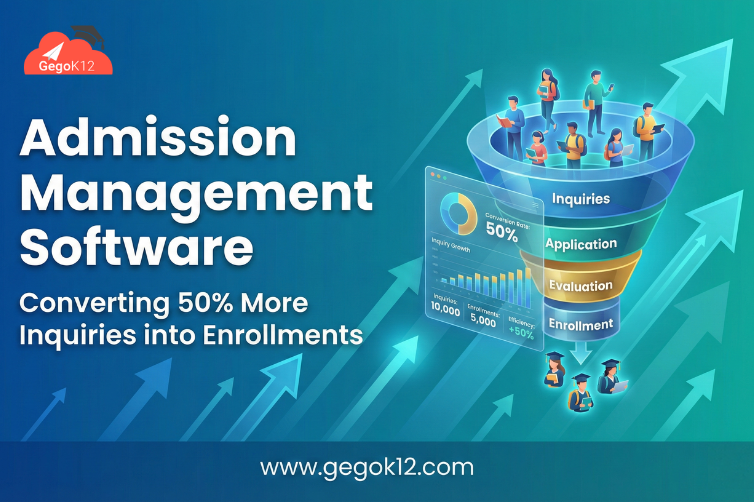
School admissions represent the lifeblood of institutional growth, yet many schools convert only 10-25% of inquiries into actual enrollments. The gap between interest and enrollment represents millions in lost revenue and hundreds of unfilled seats annually. Modern admission management software bridges this gap through automated workflows, intelligent lead nurturing, and data-driven insights that transform how schools attract, engage, and enroll students. Schools implementing comprehensive admission systems report 50-80% increases in inquiry-to-enrollment conversion rates—transforming admissions from administrative burden into strategic enrollment engine.
The admission journey involves dozens of touchpoints across months-long timelines. Parents research multiple schools simultaneously, compare options continuously, and make decisions based on factors ranging from academic reputation to communication responsiveness. Traditional manual processes—paper forms, spreadsheet tracking, delayed responses—create friction at every stage. Applications get lost, follow-ups miss timing, communications feel generic, and promising leads slip away to competitors who respond faster. Admission management software eliminates these inefficiencies through automation, personalization, and intelligent engagement that keeps prospective families moving toward enrollment.
Understanding the current admission landscape and technology solutions available helps schools make strategic investments in systems that deliver measurable enrollment growth. This comprehensive guide explores how modern admission management software transforms inquiry-to-enrollment conversion rates through proven strategies and technologies.
The Admission Conversion Crisis: Why Schools Lose Students
Most schools dramatically underestimate how many potential enrollments they lose through admission process inefficiencies. Research shows troubling patterns across educational institutions:
Inquiry Response Time Crisis Studies indicate 70% of student inquiries never receive direct human response within 24 hours. Meanwhile, leads receiving responses within 5 minutes convert 21 times more effectively than those waiting hours or days. Every minute delay decreases conversion probability. Yet most schools take 24-48 hours for initial inquiry responses—if they respond at all. By the time admissions staff contact interested families, prospects have often already engaged with faster-responding competitors.
The speed-to-lead problem compounds throughout the admission cycle. Applications sit incomplete for weeks awaiting follow-up. Document submission requests get lost in email. Fee payment instructions arrive days late. Each delay provides opportunities for families to reconsider, explore alternatives, or simply lose enthusiasm. Speed isn’t just convenient—it’s conversion-critical in today’s competitive enrollment environment.
Application Abandonment Rates Research shows 40-60% of started applications remain incomplete, representing massive enrollment potential left unrealized. Families begin applications with genuine interest but abandon mid-process due to complexity, confusion, unclear requirements, or lack of timely assistance. Traditional paper-based or poorly designed online applications create friction that drives away qualified prospects at the crucial conversion moment.
Common abandonment triggers include excessive form length (applications requiring 30+ minutes), unclear fee structures (families uncertain about costs), confusing document requirements (unclear what to submit or how), technical difficulties (website errors, payment processing failures), and lack of support (no one available to answer questions during application process).
Follow-Up Gaps and Communication Failures Manual admission processes rely on staff remembering to follow up at appropriate times. Reality proves different—busy admission teams juggling hundreds of inquiries inevitably miss follow-ups, send generic communications, or contact families at suboptimal times. Studies show personalized, timely communication increases conversion rates 3-5 times compared to generic or delayed outreach.
Effective admission nurturing requires multiple touchpoints over weeks or months—initial inquiry response, application reminder, document submission follow-up, fee payment notification, enrollment confirmation, and pre-enrollment engagement. Manual systems struggle maintaining consistent communication across hundreds of prospects simultaneously. Important leads fall through cracks while less-promising prospects receive disproportionate attention simply because they contacted admissions staff directly.
The True Cost of Admission Inefficiency Consider a school receiving 500 admission inquiries annually with 20% conversion rate—100 enrollments. With average tuition of $5,000, that represents $500,000 annual revenue. Improving conversion rate to 30% through better admission management adds 50 enrollments and $250,000 revenue—without increasing marketing spend or inquiry volume. Over a student’s school lifetime (5+ years), that single cohort improvement generates $1.25 million additional revenue.
Most schools leave this money on the table not because they lack qualified prospects but because admission processes create unnecessary friction. Admission management software addresses these inefficiencies systematically, enabling dramatic conversion improvements through automation and optimization.
Understanding Admission Conversion Metrics
Before improving conversion rates, schools must measure them accurately. Admission conversion occurs across multiple stages, each requiring monitoring:
Inquiry-to-Application Conversion Rate Measures the percentage of inquiries that submit applications. Formula: (Applications Submitted ÷ Total Inquiries) × 100. Industry benchmarks vary by school type—typically 15-35% for K-12 schools. Low rates indicate problems with initial engagement, unclear application processes, or ineffective inquiry follow-up. High-performing schools achieve 40-50% inquiry-to-application rates through responsive communication and streamlined application experiences.
Application-to-Enrollment Conversion Rate (Yield Rate) Tracks applications that result in actual enrollment. Formula: (Enrollments ÷ Applications) × 100. Typical rates range 30-60% depending on selectivity and competition. Low yield rates suggest application review delays, unclear enrollment steps, fee payment friction, or competitor losses. Top-performing schools achieve 70-80% yield through personalized engagement and frictionless enrollment processes.
Overall Inquiry-to-Enrollment Conversion Rate The comprehensive metric measuring total funnel effectiveness. Formula: (Enrollments ÷ Total Inquiries) × 100. Overall rates typically range 3-25% depending on school type, location, and reputation. This metric reveals true admission efficiency—how effectively schools convert interest into enrollment across the entire journey.
Schools should track these metrics monthly, by source (website, social media, referrals), by grade level, and by staff member when possible. Data-driven decision making enables targeted improvements at specific funnel stages rather than generic enhancement attempts.
Core Features of Effective Admission Management Software
Modern admission management systems provide comprehensive functionality addressing every admission stage:
Intelligent Inquiry Management
Centralized Lead Database Admission software consolidates all inquiries regardless of source—website forms, phone calls, walk-ins, social media, advertisements—into single, searchable database. No more lost sticky notes, scattered spreadsheets, or forgotten email threads. Every inquiry receives unique profile tracking all interactions, communications, and status updates.
Integration capabilities connect school websites, Facebook Lead Ads, Google Ads, and other marketing channels directly to admission software. Website inquiry forms automatically create lead records. Social media inquiries sync instantly. Marketing campaign responses flow directly into admission pipeline. This consolidation ensures no inquiry escapes notice regardless of contact channel.
Automated Lead Scoring and Prioritization Advanced systems analyze inquiry data—engagement level, application progress, communication responsiveness, school visits, website activity—to score lead quality automatically. High-scoring leads receive priority attention while lower-scoring prospects enter automated nurture campaigns. This intelligent prioritization ensures admission staff focus limited time on prospects most likely to convert.
Lead scoring considers multiple factors: inquiry source quality (referrals score higher than cold website visits), engagement level (attending open houses, downloading brochures, asking questions), application progress (started application indicates serious interest), response timing (immediate responses suggest urgency), and stated preferences matching school offerings.
Instant Automated Responses The moment an inquiry arrives—even at midnight or during weekends—automated systems send personalized acknowledgment emails. These instant responses keep your school top-of-mind while competitors sleep. Automated messages can include school information, application links, virtual tour invitations, and FAQ answers—providing immediate value while human follow-up waits for business hours.
Research proves instant acknowledgment dramatically improves conversion. Families appreciate immediate responses demonstrating school efficiency and attentiveness. Even if comprehensive follow-up waits for staff availability, instant acknowledgment prevents prospects from feeling ignored during critical initial contact moments.
Online Application and Document Management
Customizable Application Forms Unlike paper forms or rigid templates, modern systems allow schools to create custom application forms matching specific requirements. Different forms for different grade levels, programs, or applicant types. Multi-step applications breaking complex processes into manageable sections. Conditional logic showing relevant questions based on previous answers. Form builders with drag-and-drop interfaces make customization accessible even for non-technical staff.
Mobile-responsive forms ensure families can apply from smartphones and tablets—critical since research shows 60%+ of school website traffic comes from mobile devices. Applications that don’t work smoothly on mobile devices create abandonment and frustration.
Progress Tracking and Automated Reminders Application abandonment rates drop dramatically when systems automatically remind families about incomplete applications. Email and SMS reminders sent at strategic intervals (24 hours after starting, 3 days later, 1 week later) bring families back to complete applications. Progress bars showing completion percentage motivate families to finish.
Admission staff see dashboard views of all in-progress applications with completion status. They can identify stuck applications and reach out proactively to provide assistance. Rather than waiting for applications to arrive, staff actively guide families through completion.
Secure Document Upload and Verification Modern systems provide secure portals where families upload required documents—birth certificates, previous school records, medical forms, photo identification. No more lost faxes, misplaced mail, or incomplete files. Documents link directly to application records. Automated checklist tracking shows what’s received and what’s missing.
Document verification features allow staff to mark documents as reviewed and approved. Automated reminders notify families about missing documents with specific instructions for submission. Some advanced systems even use OCR (optical character recognition) to extract data from uploaded documents automatically, reducing manual data entry.
Integrated Payment Processing Application fees, registration deposits, and tuition payments integrate seamlessly within admission workflow. Families pay online via credit card, debit card, or digital payment methods without leaving the application portal. Payment confirmation triggers automated workflows—sending receipts, updating application status, notifying staff of payment completion.
Flexible payment options improve conversion—allowing installment plans, payment deferrals, or need-based adjustments without manual intervention. Fee management automation extends beyond admissions into ongoing tuition collection, but starts with frictionless application fee processing.
Communication Automation and Personalization
Multi-Channel Communication Effective admission nurturing requires reaching families through preferred communication channels—email, SMS, WhatsApp, phone calls. Modern systems support automated communication across all channels based on family preferences and engagement patterns. Email for detailed information, SMS for time-sensitive reminders, WhatsApp for conversational engagement in regions where it’s popular.
Communication templates with merge fields personalize messages automatically—using student names, referring to specific programs of interest, mentioning campus visit dates. Personalization makes automated messages feel individual rather than mass-produced.
Drip Campaigns and Nurture Sequences Rather than single communications, effective admission nurturing involves sequences of messages over weeks or months. Drip campaigns automatically send scheduled messages guiding families through the admission journey. Example sequence: inquiry acknowledgment (immediate), school information packet (day 2), application reminder (day 5), virtual tour invitation (day 10), testimonial stories (day 15), limited-time enrollment incentive (day 30).
Drip campaigns adapt based on family actions. If a family completes the application, they exit the application reminder sequence and enter the enrollment confirmation sequence. If they visit campus, they receive follow-up related to their visit. This intelligent sequencing ensures relevant communication at appropriate times without staff manually managing hundreds of individual communication schedules.
Two-Way Communication Platforms Modern admission software isn’t just about broadcasting messages—it’s about enabling conversation. Parent communication apps and admission chat features allow families to ask questions and receive answers quickly. SMS text messaging capabilities let admission staff have casual conversations rather than formal email exchanges.
Chatbots answer common questions 24/7—application deadlines, fee structures, program details, campus visit scheduling. When questions exceed chatbot capabilities, they seamlessly transfer to human admission staff during business hours. This combination of automated and human interaction ensures families receive immediate assistance whenever they need it.
Analytics, Reporting, and Optimization
Real-Time Dashboard Metrics Admission directors need visibility into funnel performance at any moment. Dashboard displays show current inquiries, applications in progress, pending decisions, confirmed enrollments. Conversion rates by stage, by source, by staff member. Trends over time compared to previous years. All accessible from any device without generating manual reports.
Real-time visibility enables proactive management. Directors see when inquiries drop and investigate immediately rather than discovering problems weeks later. They identify high-performing marketing channels and allocate budget accordingly. They spot staff members who convert leads exceptionally well and understand their techniques for replication across the team.
Source Tracking and ROI Analysis Every marketing dollar should contribute to measurable results. Admission software tracks where each inquiry originates—Facebook ads, Google search, school website, referrals, open houses, specific campaigns. This source attribution reveals which marketing investments generate qualified leads and enrollments versus those wasting budget on low-quality prospects.
ROI analysis calculates cost-per-inquiry and cost-per-enrollment by channel. If Facebook ads generate inquiries at $25 each but Google search generates them at $50, but Google inquiries convert at 40% while Facebook converts at 10%, the higher-cost Google channel actually delivers better enrollment ROI. Data-driven source analysis prevents gut-feeling marketing decisions that waste budget.
Predictive Analytics and Enrollment Forecasting Advanced systems use historical data and current pipeline status to forecast enrollment outcomes. Predictive models analyze past years’ conversion rates, current inquiry volumes, application progress rates, and seasonal patterns to project how many enrollments to expect by grade level and program. This forecasting enables proactive enrollment management—ramping up marketing if projections fall short, preparing for capacity if projections exceed targets.
Machine learning algorithms identify patterns predicting which leads are most likely to convert. Families matching high-conversion profiles receive prioritized attention. Lower-probability leads enter extended nurture campaigns or get de-prioritized when admission staff must allocate limited time strategically.
Strategic Implementation for Maximum Conversion Impact
Technology alone doesn’t improve conversion—strategic implementation does. Schools should follow proven deployment approaches:
Phase 1: Foundation and Data Migration
Audit Current Admission Process Before implementing software, document current processes completely. Map every step from initial inquiry through enrollment confirmation. Identify pain points where families experience friction. Measure baseline conversion rates by stage. Understand exactly what problems need solving so software configuration addresses them specifically.
Staff interviews reveal insights data doesn’t—why applications get delayed, which questions families ask repeatedly, where communication breakdowns occur. This qualitative understanding informs software configuration decisions.
Data Cleanup and Migration Most schools have years of admission data scattered across spreadsheets, paper files, and old systems. Before migrating to new software, clean this data—remove duplicates, standardize formats, validate contact information. Dirty data migrated to new systems causes ongoing problems.
Consider which historical data actually needs migration. Current year prospects and past 1-2 years for trend analysis typically suffice. Migrating decade-old inquiries that never converted provides little value while consuming significant cleanup time.
Configure and Customize Use initial configuration time to customize software matching school processes and needs. Create application forms reflecting actual requirements. Set up communication templates with school branding and appropriate tone. Configure automated workflows matching desired admission journey. Define user roles and permissions ensuring staff access what they need without system-wide administrative rights creating security risks.
Schools implementing open-source school ERP solutions benefit from customization flexibility closed proprietary systems don’t offer. Organizations like GegoK12 provide admission modules that integrate seamlessly with broader school management functionality—attendance, academics, communications—creating unified data ecosystems rather than disconnected tools.
Phase 2: Staff Training and Change Management
Comprehensive System Training Technology doesn’t improve results if staff don’t use it effectively. Invest in thorough training covering not just button-clicking but strategic system use. How to prioritize leads. When to send personalized messages versus using templates. How to interpret analytics for decision-making. Best practices for follow-up timing and frequency.
Training should continue beyond initial rollout. Regular refresh sessions, new feature training, and ongoing support resources help staff continually improve their system utilization. Teacher time management principles apply equally to admission staff—technology should reduce workload, not add complexity.
Process Documentation and Standardization Document standardized admission processes using the new software. When should initial inquiry responses occur? What information should they contain? When do applications get reviewed? How quickly should decisions be communicated? Standardization ensures consistent family experience regardless of which staff member handles their inquiry.
Process documentation also facilitates staff transitions. When admission team members change, new staff can reference documented procedures rather than relying entirely on tribal knowledge that walks out the door with departing employees.
Gradual Rollout and Iteration Rather than switching everything overnight, consider phased rollout. Start with inquiry management while continuing manual application processing. Once inquiry management works smoothly, add online applications. Then layer in automated communications, followed by advanced analytics. Gradual implementation allows staff to build competence progressively rather than getting overwhelmed by everything simultaneously.
Collect staff feedback throughout implementation. What works well? What causes confusion? What features need adjustment? Iterative refinement based on actual use creates better outcomes than rigid adherence to initial implementation plans ignoring real-world complications.
Phase 3: Optimization and Continuous Improvement
A/B Testing Communication Strategies Don’t assume initial communication templates and timing work optimally. Test variations systematically. Send one inquiry segment emails with subject line A, another with subject line B. Measure which generates better open rates and application starts. Test different follow-up timing. Try various call-to-action phrasing. Data reveals what actually works versus what sounds good theoretically.
Schools can test application form variations too. Does a single long form or multi-step process convert better? Do families complete applications more when fee information appears upfront or near the end? Systematic testing uncovers conversion optimizations generating meaningful enrollment gains without additional marketing spend.
Regular Analytics Review and Strategy Adjustment Schedule monthly admission performance reviews examining conversion metrics, source effectiveness, staff performance, and year-over-year trends. Use these reviews to make evidence-based strategy adjustments. If certain inquiry sources convert poorly, reduce investment there. If specific communication sequences show exceptional effectiveness, replicate them across all prospects.
Analytics might reveal surprising patterns—perhaps inquiries from mobile devices convert poorly because your application form doesn’t work well on smartphones. Maybe afternoon inquiries convert better than morning ones, suggesting optimal staff scheduling. Data-driven insights enable continuous improvement impossible with gut-feeling management.
Competitive Analysis and Benchmark Comparison Research competitor admission processes periodically. Submit inquiry forms to rival schools. Experience their response speed, communication quality, application ease. Identify what they do exceptionally well that your school could adopt. Understand where your processes excel so you emphasize those advantages in marketing.
Industry benchmarks help contextualize performance. Are your 25% inquiry-to-enrollment rates excellent or concerning? Depends on school type, location, selectivity. Understanding benchmark ranges helps set realistic improvement targets and identify whether problems exist relative to comparable schools.
Addressing Common Implementation Challenges
Schools implementing admission management software encounter predictable challenges. Anticipating them enables proactive solutions:
Staff Resistance to Change Admission staff comfortable with familiar processes resist new systems they perceive as complicated or threatening. Address resistance through early involvement—include staff in software selection and configuration decisions. Emphasize how software reduces their workload rather than adding to it. Provide extensive training and support. Celebrate early wins demonstrating system benefits.
Some resistance comes from fear of technology revealing poor performance. Frame implementation as improvement opportunity for everyone rather than performance monitoring exercise. Focus on collective enrollment goals rather than individual metrics, at least initially.
Integration with Existing Systems Schools running admission software alongside separate school management systems or student information systems face integration challenges. Data shouldn’t be manually re-entered across multiple systems. Look for admission software that integrates with or is part of comprehensive school ERP platforms like GegoK12, which provides admission management alongside attendance, academics, fee collection, and communication in unified systems.
Integration challenges extend to third-party tools—payment processors, SMS gateways, email marketing platforms, website forms. Prioritize software with robust API capabilities and pre-built integrations with commonly used tools. Cloud-based solutions typically offer better integration flexibility than legacy on-premise systems.
Maintaining Data Quality Automated systems amplify data quality problems. If staff enter inconsistent information—names in different formats, incomplete contact details, unclear inquiry sources—analytics and automation suffer. Establish data entry standards and train staff in proper data hygiene. Use validation rules preventing obviously incorrect entries. Conduct periodic data quality audits identifying and correcting problems.
Encourage “clean as you go” mentality rather than letting bad data accumulate for eventual cleanup projects. Small consistent attention to data quality prevents larger problems later.
Balancing Automation and Personal Touch Excessive automation makes communications feel impersonal and generic despite personalization tokens. Schools should blend automation handling routine communications (confirmations, reminders, informational content) with personalized human outreach for high-value interactions (addressing specific questions, discussing concerns, celebrating acceptance).
Define which communications should remain personal versus automated. Application decisions, scholarship offers, and enrollment celebrations warrant personal attention. Routine reminders, general information, and administrative confirmations suit automation. Finding the right balance maintains efficiency without sacrificing relationship-building that distinguishes your school from competitors.
The ROI of Admission Management Software
Schools should view admission software as enrollment investment rather than cost:
Direct Revenue Impact For a school with 500 inquiries annually converting at 20% (100 enrollments) with $5,000 average tuition, improving conversion to 30% adds 50 students and $250,000 annual revenue. Quality admission software costs $3,000-$10,000 annually—providing 25-80x return on investment in first year alone. Multi-year student retention multiplies returns further.
Even modest conversion improvements justify software investment. Moving from 20% to 25% conversion adds 25 students and $125,000 revenue—massive return on software subscription costs. Schools cannot afford NOT investing in tools dramatically improving enrollment outcomes.
Operational Efficiency Gains Beyond enrollment increases, admission software reduces staff time required per inquiry. Manual processes might require 30-60 minutes per inquiry for data entry, follow-up management, application processing. Automation reduces this to 10-15 minutes. For 500 inquiries, that’s 125-375 hours saved annually—equivalent to 3-9 weeks of full-time staff capacity redirected toward high-value personal engagement rather than administrative tasks.
Efficiency gains enable smaller admission teams to handle larger inquiry volumes without proportional staffing increases. As school grows, admission software scales much more cost-effectively than hiring additional staff.
Marketing Effectiveness Improvement Admission software’s source tracking and conversion analytics ensure marketing budgets focus on effective channels. Schools commonly waste 30-50% of marketing spend on sources generating low-quality leads that never convert. Data-driven budget reallocation improves marketing ROI without increasing total spending.
Better conversion rates also reduce cost-per-enrollment even with constant marketing spend. If marketing generates 500 inquiries at $10,000 total cost ($20 per inquiry), converting at 20% yields 100 enrollments at $100 each. Improving conversion to 30% yields 150 enrollments at $67 each—33% cost reduction per enrolled student.
Competitive Advantage and Market Position Schools with responsive, professional admission processes gain competitive advantages in local markets. Families researching multiple schools simultaneously choose those providing fastest responses, clearest information, and easiest application experiences. Admission software enables responsiveness and professionalism that manual processes cannot match.
This competitive edge compounds over time. Schools known for excellent admission experiences attract more referrals. Positive word-of-mouth reduces marketing costs while increasing inquiry quality. Reputation for efficiency and attention builds institutional brand differentiating you from competitors still using paper forms and manual tracking.
Free and Open-Source Alternatives
Schools with limited budgets can access powerful admission management capabilities through open-source solutions:
GegoK12 Admission Module GegoK12’s open-source school ERP includes comprehensive admission management functionality—inquiry tracking, online applications, document management, communication automation, analytics—without per-user licensing fees. Schools self-hosting GegoK12 pay only for server infrastructure while accessing enterprise-grade admission features.
The open-source model provides transparency, customization flexibility, and freedom from vendor lock-in. Schools can modify source code to meet unique needs or integrate with local payment gateways and communication services. Community development ensures continuous improvement without dependence on single commercial vendor’s priorities.
Cost Considerations Beyond Software While free admission tools eliminate software licensing costs, schools should budget for implementation time, staff training, hosting infrastructure (for self-hosted solutions), and ongoing system administration. “Free” doesn’t mean zero-cost—it means cost structure differs from commercial software subscriptions.
However, total cost of ownership typically remains far lower than commercial alternatives, especially for schools with technical capacity for self-hosting and configuration. Organizations like GegoSoft provide professional implementation and support services for schools needing assistance while maintaining open-source core platform benefits.
Hybrid Approaches Some schools adopt hybrid strategies—using free open-source admission software while subscribing to specialized services for specific needs like SMS messaging, payment processing, or advanced analytics. This approach balances cost savings with targeted investments in areas where commercial services provide exceptional value.
FAQ: Admission Management Software Questions
Q: How much does admission management software typically cost?
Commercial admission software pricing varies widely—from $1,000-$10,000+ annually depending on school size, feature requirements, and vendor. Per-student pricing models typically charge $1-$5 per enrolled student annually. Open-source alternatives like GegoK12’s free admission tools eliminate licensing costs, with schools paying only for hosting infrastructure and optional support services.
Q: Can small schools with limited inquiries benefit from admission software?
Absolutely. Even schools with 100 annual inquiries benefit from improved conversion rates and staff efficiency. Conversion improvement from 15% to 30% adds 15 students—potentially $75,000+ revenue for schools with $5,000 tuition. Software costs pale compared to enrollment gains even at small scales. Additionally, automation allows small admission teams to handle growth without proportional staffing increases.
Q: How long does implementation typically take?
Basic implementation (data migration, initial configuration, staff training) typically requires 4-8 weeks. Full deployment with customized workflows, advanced automation, and staff adoption takes 2-4 months. Schools should allow one full admission cycle for complete system optimization as staff gain experience and iteratively improve processes based on real-world use.
Q: Will families complete online applications or do they prefer paper forms?
Research shows 85% of parents prefer online admission systems for convenience and transparency. Mobile-friendly online applications align with how families research schools—primarily through smartphones and tablets. Paper forms are increasingly seen as outdated and inconvenient rather than traditional or personal. Schools should maintain paper options for families without internet access while defaulting to online processes.
Q: How do we ensure data security and privacy with admission software?
Reputable admission software providers implement robust security—encrypted data transmission, secure database storage, role-based access controls, regular security audits, compliance with student data privacy regulations. Schools should verify security certifications, review privacy policies, and establish data handling agreements. Open-source solutions offer transparency advantages—code can be audited for security rather than relying solely on vendor claims.
Q: Can admission software integrate with our existing school management system?
Integration capabilities vary by platform. Cloud-based solutions typically offer API access and pre-built integrations with popular school management systems. Comprehensive school ERP platforms like GegoK12 include admission management alongside student information, academics, and fee collection in unified systems—eliminating integration challenges through all-in-one architecture. Ask vendors about specific integration options with your current systems before purchasing.
Transforming Admissions from Administrative Burden to Enrollment Engine
Admission management software represents strategic investment in institutional growth rather than operational expense. Schools cannot afford losing 70-90% of inquiries to process inefficiencies while competitors using modern systems convert prospects more effectively. The gap between manual admission processes and automated intelligent systems widens annually as technology capabilities advance and family expectations increase.
Implementation requires upfront effort—data migration, staff training, process redesign. But returns emerge quickly. Schools consistently report conversion improvements within first admission cycle, with optimization driving continuous improvement in subsequent years. The compounding effect of higher conversion rates, operational efficiency, marketing effectiveness, and competitive positioning builds sustainable enrollment advantages that manual processes cannot match.
Whether implementing comprehensive commercial platforms or adopting free open-source admission tools, the path forward is clear. Modern families expect responsive, professional, digital-first admission experiences. Schools providing these experiences through intelligent admission management software will thrive while those clinging to manual processes struggle with declining enrollment and increasing acquisition costs.
The admission transformation journey begins with single step—evaluating current processes, measuring baseline conversion rates, and exploring software options aligning with institutional needs and budgets. Schools taking this step position themselves for enrollment growth, operational excellence, and competitive success in increasingly challenging educational markets.
Your next 100 enrollments are already in your inquiry database. The question is whether your admission processes convert them—or lose them to schools that will.