
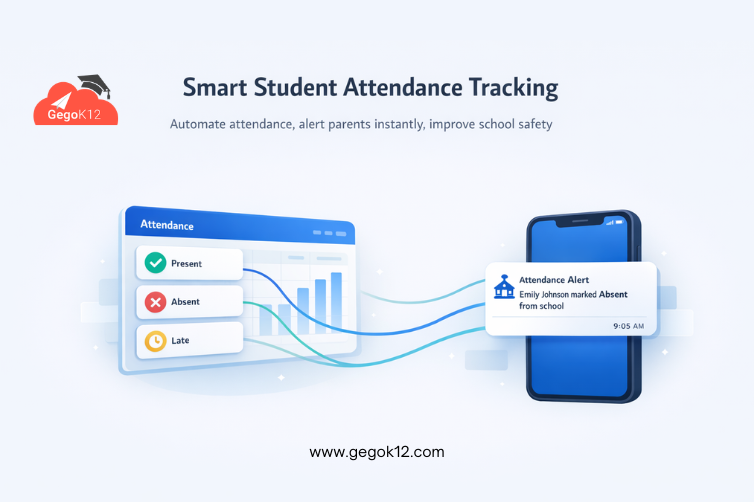
Quick Answer: A student attendance tracking system is a digital platform that automates daily attendance marking, sends instant notifications to parents when students are absent, generates compliance reports, and provides real-time attendance analytics — eliminating paper registers, reducing marking time from 15 minutes to under 2 minutes per class, and ensuring parents know immediately if their child didn’t reach school safely.
Attendance tracking represents one of the most fundamental yet operationally intensive daily school tasks. Teachers mark attendance every period, schools compile daily reports, parents worry about whether their children arrived safely, and administrators need accurate records for compliance and funding. Traditional paper-based attendance systems create inefficiencies, errors, and concerning safety gaps — when students are marked present but actually absent, parents remain unaware of potential safety issues for hours.
Research shows that automated student attendance tracking system reduce teacher time spent on attendance by 85%, improve accuracy rates from 90% to 99.5%, and dramatically enhance school safety through instant parent notifications. With attendance directly impacting school funding in many regions and parent safety concerns at all-time highs, digital attendance management has evolved from convenience feature to operational necessity.
This comprehensive guide explains how modern attendance systems work, what features deliver real value beyond basic roll-call digitization, and how GegoK12’s integrated attendance management platform provides complete automation without expensive licensing costs.
The Hidden Costs of Paper Attendance Registers
Daily Time Consumption
Teacher Time Per Class: Manual attendance marking consumes 5-8 minutes per class period — calling names, marking registers, noting latecomers, and recording reasons for absences. With 6-8 periods daily, teachers spend 30-50 minutes on attendance marking alone.
School-Wide Impact: For a school with 40 teachers, this represents 20-35 person-hours daily, or 100-175 hours weekly consumed purely by attendance marking. At ₹400/hour average cost, this represents ₹40,000-70,000 in weekly labor costs for attendance alone.
Administrative Compilation: School offices manually compile daily attendance from class registers, calculate section-wise and grade-wise totals, identify chronic absentees, and prepare monthly reports — adding 10-15 hours weekly to administrative workload.
Safety and Communication Gaps
Delayed Parent Notification: Parents discover their child’s absence only when the child fails to return home or through evening phone calls from school. This 6-8 hour notification delay creates genuine safety concerns when students skip school without parental knowledge.
Attendance Fraud: Paper registers allow students to mark friends as present when they’re actually absent. This manipulation creates safety risks, inaccurate records, and prevents early intervention for chronic absenteeism.
Accuracy and Compliance Issues
Recording Errors: Manual entry creates 8-12% error rates — misread handwriting, incorrect tallying, lost register pages, or simple marking mistakes. These errors affect funding calculations, compliance reporting, and academic analytics.
Report Generation Complexity: Monthly, quarterly, and annual attendance reports require hours of manual compilation from paper registers. Missing pages, unclear entries, and transcription errors complicate reporting while consuming significant administrative time.
GegoK12’s digital attendance system eliminates every one of these issues through automated marking, instant parent alerts, real-time reporting, and comprehensive audit trails preventing manipulation.
How Student Attendance Tracking System Work
Modern student attendance tracking system operate through integrated digital workflows:
Quick Digital Marking
Teachers access attendance interfaces through tablets, smartphones, or classroom computers. Class lists display with simple tap/click interfaces — present, absent, late, excused absence. Visual interfaces with student photos enable rapid marking without calling names individually.
Most teachers complete attendance for 40-student classes in under 90 seconds using digital systems compared to 5-8 minutes with paper registers. This efficiency compounds across 6-8 daily periods, saving 25-40 minutes of teacher time daily.
Automatic Parent Notifications
The moment a teacher marks a student absent, the system automatically sends notifications to registered parent contacts through multiple channels:
SMS Alerts: Text messages arrive within seconds of absence marking: “Your child [Name] is marked absent from school today [Date]. If this is unexpected, please contact school immediately.”
Mobile App Push Notifications: Parents using school mobile applications receive instant push notifications with absence details, ensuring immediate visibility even if SMS is missed.
Email Notifications: Automated emails provide detailed attendance information including which periods were missed, whether absence was excused, and any notes from teachers or school office.
This instant multi-channel notification ensures parents know within minutes, not hours, if their child didn’t arrive at school — dramatically improving student safety.
Real-Time Attendance Dashboards
School administrators access live attendance dashboards showing:
Current Day Status: Real-time view of which students are present, absent, or late across all classes. Color-coded visualizations highlight unusual patterns requiring attention.
Historical Trends: Weekly, monthly, and yearly attendance patterns reveal chronic absenteeism, improving attendance trends, or concerning declines requiring intervention.
Section and Grade Analysis: Comparative attendance rates across sections and grades identify which groups need targeted attendance improvement initiatives.
Individual Student Tracking: Complete attendance history for any student, showing patterns, reasons for absences, and total days missed — critical for academic performance analysis and intervention planning.
Automated Report Generation
Rather than manually compiling attendance data from paper registers, digital systems generate comprehensive reports instantly:
Daily Reports: Automated compilation of daily attendance by class, grade, and school-wide totals — generated in seconds rather than requiring 30-60 minutes of manual work.
Monthly Summaries: Detailed monthly attendance analysis including student-wise attendance percentages, chronic absenteeism identification, and trend comparisons to previous months.
Compliance Reports: Format-specific reports meeting education department requirements, board specifications, or funding agency documentation needs — automatically generated from attendance data without manual reformatting.
Integration with Academic Management
Attendance doesn’t exist in isolation — it directly impacts academic performance and should inform intervention decisions. Integrated school management platforms connect attendance data with grade tracking, showing correlations between absence patterns and academic decline.
When students exhibit both declining attendance and falling grades, the system flags them for counselor intervention, ensuring coordinated support addressing both issues simultaneously.
Essential Features of Effective Attendance Systems
Multiple Marking Methods
Different school contexts require different marking approaches:
Period-Based Marking: Secondary schools marking attendance each period to monitor late arrivals and between-period absences.
Daily Marking: Elementary schools marking attendance once daily at school start, with supplementary marking for afternoon sessions if needed.
Biometric Integration: Some schools use fingerprint or facial recognition for automated attendance capture as students enter buildings, eliminating manual marking entirely while preventing fraud.
RFID/Card Systems: Students scan ID cards at entry points, automatically recording arrival times while creating contactless attendance capture during high-volume morning arrivals.
GegoK12 supports all marking methods through configurable options, allowing schools to choose approaches matching their operational preferences and infrastructure.
Excuse and Leave Management
Not all absences are equal — medical appointments, family emergencies, religious observances, and school-sanctioned activities all create legitimate absences requiring different treatment than unexcused truancy.
Effective systems allow:
Advance Leave Requests: Parents submit leave applications through mobile apps or web portals before planned absences, with approval workflows routing requests to appropriate authorities.
Excuse Notes: Parents provide absence explanations through digital forms, attaching supporting documentation (medical certificates, appointment confirmations) directly to absence records.
Excuse Categories: Schools configure absence types (illness, family emergency, religious observance, school activity) for accurate categorization supporting compliance reporting and absence analysis.
Attendance Analytics and Insights
Raw attendance data gains value through intelligent analysis revealing patterns and trends:
Chronic Absenteeism Identification: Automatic flagging of students missing specified thresholds (typically 10% of school days), triggering intervention protocols.
Pattern Recognition: Identifying students with suspicious patterns — absent every Monday, missing specific subject periods consistently — suggesting truancy rather than legitimate absences.
Correlation Analysis: Linking attendance patterns to academic performance, behavioral incidents, or other student factors — revealing relationships informing support strategies.
Predictive Alerts: Machine learning algorithms identifying students at risk of chronic absenteeism based on early pattern indicators, enabling proactive intervention before attendance problems become severe.
Parent Communication Tools
Beyond automated absence alerts, comprehensive systems provide:
Attendance Summaries: Weekly or monthly summaries showing parents their child’s complete attendance record, helping families monitor attendance proactively.
Improvement Tracking: Progress updates when students with poor attendance show improvement, recognizing positive change while maintaining accountability.
Two-Way Communication: Parents can respond to absence notifications, provide explanations, or request excuse approval directly through the system without requiring phone calls or office visits.
Implementation Strategy: Deploying Digital Attendance
Phase 1: System Configuration (Week 1)
Configure attendance policies and rules:
Marking Schedule: Define when attendance gets marked — period-based, daily, or both.
Notification Rules: Specify which absence types trigger parent notifications, notification timing, and message templates.
Excuse Policies: Configure leave request approval workflows, required documentation, and absence categorization standards.
Comprehensive documentation guides configuration, ensuring proper setup matching institutional policies.
Phase 2: Teacher Training (Week 2)
Train all teaching staff on digital marking procedures:
Marking Interfaces: How to access attendance screens, mark students present/absent/late, add notes about absences.
Mobile Access: Using smartphones or tablets for attendance marking, syncing data, and accessing historical records.
Correction Procedures: How to correct marking errors, change attendance records when students arrive late, or update absences to excused after receiving parent explanation.
Video tutorials provide on-demand training resources supporting teachers as they adopt digital marking workflows.
Phase 3: Parent Communication (Week 3)
Inform parents about automated attendance notifications:
SMS Registration: Ensure all parent mobile numbers are registered correctly for SMS notification delivery.
Mobile App Installation: Guide parents through school app installation and registration for push notification access.
Notification Examples: Provide sample notifications so parents recognize legitimate school messages and understand expected response procedures.
Response Expectations: Clarify what parents should do when receiving unexpected absence notifications — contact school immediately, provide explanations, or confirm awareness of planned absences.
Phase 4: Pilot Testing (Week 4)
Conduct pilot with selected classes before full deployment:
Test Marking: Teachers mark attendance digitally while maintaining parallel paper records for verification.
Notification Testing: Verify parent notifications deliver correctly with accurate information.
System Verification: Ensure reports generate accurately, data syncs properly, and no technical issues prevent smooth operation.
Feedback Collection: Gather teacher and parent feedback identifying usability improvements before school-wide launch.
Phase 5: Full Deployment
After successful piloting, deploy across entire school:
Phased Rollout: Implement grade-by-grade or section-by-section rather than entire school simultaneously, allowing focus on any issues arising during initial deployment.
Parallel Systems: Maintain paper registers as backup during first 2-3 weeks until confidence in digital system is established.
Ongoing Support: Provide readily available technical support helping teachers and parents with questions or issues during transition period.
Attendance Systems for Indian Schools
Right to Education (RTE) Compliance
RTE Act mandates specific attendance tracking and reporting requirements. GegoK12’s attendance system is designed for Indian regulatory context — supporting required documentation, generating compliant reports, and maintaining audit trails satisfying education department inspections.
Multi-Language Notifications
India’s linguistic diversity requires attendance notifications in parents’ preferred languages. GegoK12 supports SMS and app notifications in Hindi, regional languages, and English, ensuring universal parent accessibility regardless of language background.
Integration with Aadhaar
Some states require Aadhaar-based attendance for regulatory compliance or scholarship verification. GegoK12 accommodates Aadhaar integration where required while maintaining privacy safeguards ensuring appropriate data protection.
Low-Bandwidth Optimization
GegoK12’s attendance system functions effectively on basic smartphones with moderate internet connections — critical for schools in smaller cities or rural areas where parents may have entry-level devices rather than premium smartphones.
FAQs
Q: What happens if teachers forget to mark attendance?
A: The system sends automatic reminders to teachers with unmarked attendance periods. Administrators view dashboard highlighting missing attendance data, enabling direct follow-up with specific teachers to ensure complete daily records.
Q: Can we mark attendance offline if internet is unavailable?
A: Yes. GegoK12’s mobile apps support offline attendance marking. Data syncs automatically when internet connectivity restores, ensuring uninterrupted attendance tracking regardless of network availability.
Q: How do we handle attendance for students who arrive late?
A: Teachers initially mark late-arriving students as absent. When students arrive, teachers quickly update attendance status to “late” with arrival time. The system adjusts parent notifications accordingly, informing families of tardy arrival rather than full absence.
Q: Can parents view complete attendance history for their child?
A: Yes. Parents access full attendance records through parent portal applications, viewing daily attendance, absence reasons, attendance percentages, and historical trends — providing complete transparency about their child’s attendance patterns.
Measuring Attendance System Impact
Track specific metrics demonstrating value:
Teacher Time Savings: Measure time spent on attendance before and after implementation. Expect 80-85% reduction in daily attendance time.
Parent Notification Speed: Track time between student absence and parent notification. Digital systems deliver notifications within 1-2 minutes versus 6-8 hours for manual phone calls.
Accuracy Improvement: Compare error rates in attendance records. Digital systems reduce errors from 8-12% to under 0.5%.
Chronic Absenteeism Reduction: Monitor whether early intervention enabled by attendance analytics reduces chronic absenteeism rates by 20-30% through timely family engagement.
Conclusion: Transform Attendance from Burden to Asset
The student attendance tracking system represents one of the highest-impact, fastest-ROI school digitization investments. The combination of dramatic time savings, improved student safety through instant parent notifications, better data accuracy, and actionable analytics transforms attendance from administrative burden to strategic asset supporting student success.
GegoK12’s comprehensive open-source platform provides complete attendance automation integrated with all school operations — free under the MIT license, with professional support available for guided implementation.
Every day of continued paper attendance wastes teacher time, delays critical parent communication, and misses opportunities for early intervention with at-risk students.
Explore GegoK12’s attendance features, download the platform, review implementation guides, or contact the team to discuss your specific attendance management requirements.
Transform your daily attendance operations today. Choose efficiency. Choose safety. Choose GegoK12.