
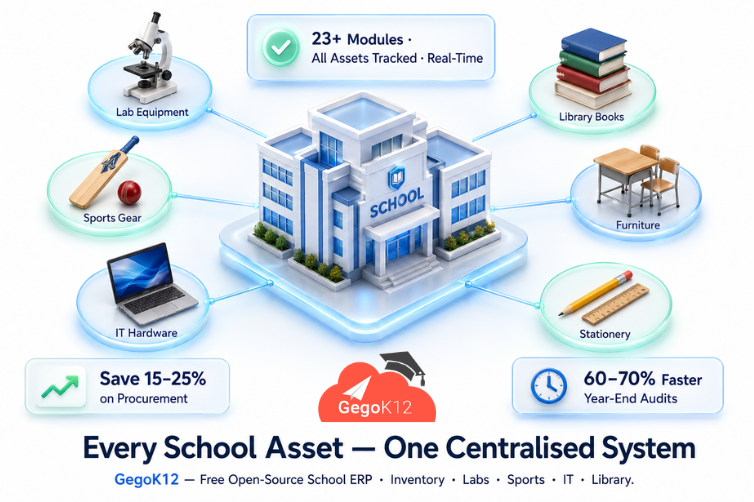
A school inventory management system is a digital tool that helps schools track, monitor, and manage all physical assets — from laboratory equipment and sports gear to stationery, furniture, and IT hardware — in one centralised platform. It eliminates stock discrepancies, prevents pilferage, reduces unnecessary procurement spending, and gives administrators real-time visibility into what the school owns, where it is, and when it needs replenishment.
Why Most Schools Are Losing Money on Inventory Without Knowing It
Walk into any school storeroom in India and you will find the same scene: stacks of registers with handwritten stock entries, shelves of equipment with no clear ownership record, duplicate purchases made because no one knew existing stock was available, and items written off as lost that were simply moved to another department.
This is not negligence — it is the inevitable result of managing school inventory manually in an institution that operates across multiple departments, classrooms, labs, sports facilities, and administrative offices simultaneously.
The financial cost is significant. A study of mid-size Indian schools found that institutions without a structured school inventory management system overspend on procurement by 15–25% annually due to duplicate orders, untracked wastage, and unrecorded losses. For a school with an annual procurement budget of ₹10 lakhs, that is ₹1,50,000 to ₹2,50,000 wasted every year on assets the school may already own.
A properly implemented school inventory management system closes this gap completely.
What a School Inventory Management System Actually Does
A school inventory management system is not just a digital stock register. When built into a comprehensive school ERP, it becomes an active asset governance tool that connects procurement, usage, maintenance, and reporting into a single workflow.
Centralised asset catalogue. Every item the school owns — from a single whiteboard marker to a science laboratory microscope — is recorded with a unique identifier, category, quantity, location, and condition status. Nothing falls through the gaps.
Department-wise stock allocation. Inventory is assigned to specific departments, classrooms, or staff members. When a teacher requests lab equipment or a sports coordinator needs kits for a tournament, the request is logged, approved, and fulfilled through the system — with stock levels updated automatically.
Low-stock alerts and reorder triggers. The system monitors stock levels against pre-set minimum thresholds. When stationery supplies, cleaning materials, or consumable lab items drop below the defined level, administrators receive automatic alerts — eliminating the emergency last-minute procurement that costs schools premium pricing.
Issue and return tracking. Items issued to teachers, students, or external vendors are tracked with issue dates, expected return dates, and actual return records. Overdue items are flagged automatically, creating accountability without requiring manual follow-up.
Audit-ready reporting. Year-end stock audits — a regulatory and governance requirement for most schools — become straightforward when the system maintains a continuous, timestamped record of every transaction. There is no reconciliation panic at the end of the financial year.
GegoK12’s Inventory Management Module: Complete Asset Control at Zero Cost
GegoK12’s open-source school management platform includes a dedicated Inventory Management module built specifically for the way Indian schools organise and operate their physical assets.
Because GegoK12 is a self-hosted, MIT-licensed platform, there are no per-module charges, no subscription tiers, and no data leaving your school’s servers. The inventory module — like all 23+ modules in the platform — is included in the core system available for free download from GegoK12’s GitHub repository.
What the GegoK12 inventory module covers:
Multi-category asset management. Schools can define and manage inventory across all categories — office supplies, laboratory equipment, sports gear, IT hardware, library materials, furniture, electrical fittings, and any custom category specific to the institution. Each category is tracked independently with its own stock levels and location records.
Stock movement logs. Every addition, issue, return, damage report, or write-off is recorded with a timestamp and the staff member responsible. This creates a permanent, auditable trail of every inventory transaction across the school’s history.
Integration with the broader school ERP. Because the inventory module sits within GegoK12’s unified platform, it connects naturally to other operational workflows. Lab equipment tracked in inventory links to science department records. Sports kit management integrates with physical education scheduling. Stationery stocks align with classroom and section records established in the classroom management module.
Role-based access control. The principal, bursar, department heads, and storeroom staff each see only the inventory data relevant to their role. A science teacher can check available lab equipment without accessing the school’s full procurement records. Access is structured, secure, and appropriate to each user’s responsibilities.
Vendor and procurement records. Purchase entries record supplier details, invoice references, unit costs, and procurement dates alongside stock quantities. This gives finance administrators a complete picture of asset value and procurement history — essential for budget planning and annual audits.
Setting Up Your School Inventory Management System with GegoK12
Getting the inventory module operational is straightforward. Schools that follow a phased approach are typically managing inventory digitally within two to three weeks.
Phase 1 — Initial stock audit (Week 1). Before importing data, conduct a physical count of existing assets across all departments. This one-time exercise creates the baseline inventory that the digital system will manage going forward. GegoK12 supports CSV-based bulk import, so existing spreadsheet records can be uploaded directly rather than re-entered manually.
Phase 2 — System configuration (Week 1–2). Download GegoK12 from GitHub and configure the platform following the technical documentation. Set up inventory categories, define minimum stock thresholds, and assign department-wise access permissions. The GegoK12 video tutorial library includes guided walkthroughs for inventory module setup.
Phase 3 — Staff onboarding (Week 2–3). Train department heads and the storeroom manager on raising issue requests, recording returns, and logging new purchases. GegoK12’s interface is browser-based and requires no technical background to operate for day-to-day inventory tasks.
Phase 4 — Live operation and monitoring (Week 3 onwards). With the system running, administrators receive automatic low-stock alerts, department heads submit digital requisitions, and the storeroom operates from a real-time digital stock record rather than a paper register.
For schools that need guidance during any phase of this process, the GegoK12 support team provides direct deployment assistance.
The Measurable Impact on School Operations
Schools that implement a structured school inventory management system report consistent, quantifiable improvements across three areas:
Procurement savings of 15–20%. When administrators can see exactly what stock is available before raising a purchase order, duplicate procurement stops immediately. Planned reordering based on usage trends also reduces emergency purchases at premium prices.
Audit time reduced by 60–70%. Year-end stock audits that previously took a dedicated team three to five days to complete become a matter of generating a system report and conducting spot checks. The continuous digital record does the heavy work automatically.
Asset loss reduced by 30–40%. When every item issued to a department or staff member is tracked with a return expectation, accountability increases significantly. Items are returned promptly or reported as damaged — rather than quietly disappearing into classrooms or going home with staff.
Frequently Asked Questions
Q: Can the school inventory management system handle both consumable and non-consumable assets?
Yes. GegoK12’s inventory module distinguishes between consumables (stationery, lab chemicals, cleaning supplies) that are used up over time and non-consumables (furniture, equipment, IT hardware) that are tracked as long-term assets with condition records.
Q: Does it work for schools with multiple buildings or campuses?
Yes. Inventory can be organised by location — building, floor, department, or room — within the same platform. Stock at each location is tracked independently, and administrators can view consolidated or location-specific reports.
Q: How does it handle items that are damaged or written off?
The system includes damage reporting and write-off workflows. When an item is damaged beyond repair or disposed of, the record is updated with the reason, the staff member who reported it, and the date — maintaining a complete asset lifecycle history.
Q: Is there a mobile interface for inventory management?
GegoK12’s web interface is mobile-responsive, allowing storeroom staff and department heads to raise requests, log returns, and check stock levels from any smartphone browser without needing a dedicated app.
Conclusion
A school inventory management system transforms one of education administration’s most overlooked problem areas — physical asset tracking — into a controlled, transparent, and audit-ready process.
GegoK12 delivers this capability as part of its free, open-source school ERP platform, with no licensing fees and no vendor lock-in. Every stock record, procurement entry, issue log, and audit report stays on your school’s own server — fully owned and controlled by your institution.
Explore GegoK12’s complete open-source school ERP to see how the inventory module fits within the broader platform, or download directly from GitHub to begin your school’s setup. The GegoK12 team is available to support your deployment every step of the way.
Stop losing money on inventory you already own. A smarter school inventory management system starts today.