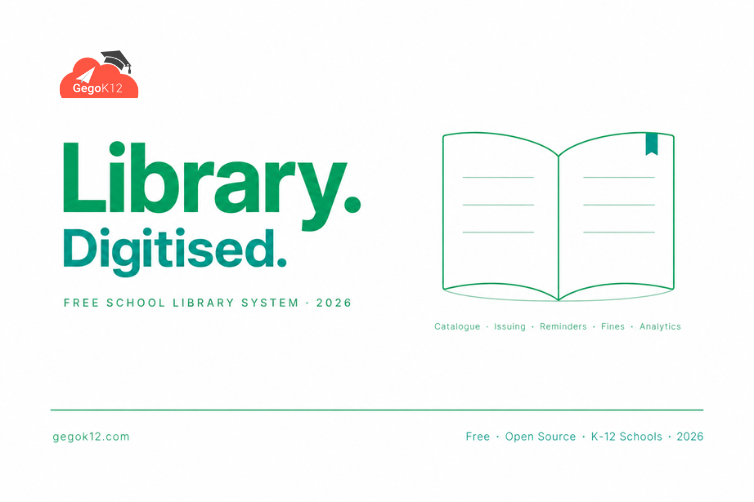
The best free school library management system in 2026 is GegoK12’s Library Management Module — a 100% free, open-source digital library solution built into the GegoK12 school ERP. It provides a centralised, searchable book catalogue, digital book issuing and return tracking, automated overdue reminders, auto-calculated fines for late returns, barcode and QR code integration for rapid processing, comprehensive usage analytics, and complete book journey history — all within a secure, role-based, school-integrated platform at zero licensing cost.
Introduction: The School Library Problem That Has Gone Unsolved for Too Long in 2026
The school library should be the intellectual heart of every educational institution. A place where students cultivate curiosity, expand their knowledge beyond the syllabus, and develop the reading habits that serve them for a lifetime.
In 2026, it is often something else entirely.
It is a room with rows of books that nobody can find. A librarian hunched over multiple registers trying to track 2,000 books across hundreds of students. A lost book that nobody can trace because the entry was made in pencil six months ago and the register has been overwritten. A student waiting while the librarian manually searches through cards to find out whether a book is available. A fine that was never collected because nobody had a record of when the book was due back.
And most painfully — a library that students have stopped using, not because they don’t want to read, but because the friction of accessing books is simply too high.
In 2026, this is a management failure, not a student engagement failure. And it has a completely free solution.
GegoK12’s Library Management System digitises every aspect of library operations — from catalogue management to book issuing, automated reminders to fine calculation, barcode scanning to usage analytics — giving your school library the operational backbone it needs to truly function as the knowledge hub it is meant to be.
What Is GegoK12 — and Why Is Library Management Part of It?
GegoK12 is a free and open-source school management system built on PHP + Laravel, MIT licensed, and designed exclusively for K-12 schools. The Library Management module is one of 23+ modules within the platform — fully integrated with the school’s student records, attendance data, communication system, and administrative tools.
This integration is significant for library management. When a student borrows a book in GegoK12, the system already knows their name, class, section, and student ID — from the Student Information Management module. When a book is overdue, the reminder goes out through the same SMS / Push Notification module that handles attendance alerts and fee reminders — one communication system for the entire school.
In 2026, a library system that is isolated from the rest of the school’s operations is a system that will never reach its full potential.
The entire platform is freely available on GitHub under the MIT licence.
The Real Cost of Manual Library Management in 2026
Most schools treat library management as a low-priority administrative function. Let’s challenge that framing by naming what poor library management actually costs.
Cost #1: Lost and Untracked Books — Direct Financial Loss
A school library with 2,000 books and manual tracking typically loses 5–10% of its collection annually to misplacement, unreturned loans, and unrecorded movement. For a library with an average book value of ₹300, that represents ₹30,000 to ₹60,000 in lost assets every year — quietly draining the school’s resources with no one calculating the bill.
Cost #2: Librarian Time Consumed by Manual Tasks
A librarian spending 2–3 hours daily on manual catalogue maintenance, handwritten issue records, and fine calculations is a professional whose expertise is being wasted on clerical work. In 2026, a librarian’s value is in curating resources, encouraging reading, and supporting curriculum — not in maintaining ledger books.
Cost #3: Student Access Friction Kills Reading Habits
When finding a book requires asking the librarian to search through physical cards, checking multiple registers, and waiting for manual confirmation of availability — students stop asking. The friction of access directly suppresses usage. Libraries with digital search and instant availability status consistently show higher borrowing rates and stronger student reading habits.
Cost #4: No Visibility Into Reading Trends
A paper-based library has no data. Which books are most borrowed? Which classes are using the library most? Which subjects have the least resources relative to curriculum demand? These are questions that a school principal asking in 2026 cannot answer without a digital system — and the answers directly inform budget allocation and procurement decisions.
Cost #5: Fine Collection Failures and Revenue Leakage
Manual fine tracking almost always results in under-collection. Books are returned late, fines are calculated inconsistently, and without automated records, students simply avoid the library when a book is overdue. The result: unpaid fines, books not returned, and no accountability.
GegoK12’s Library Management System addresses every one of these failures — completely free.
GegoK12 Library Management System: Complete Feature Breakdown (2026)
Feature 1: Centralised Digital Book Catalogue — Your Entire Library, Searchable Instantly
The foundation of an effective library in 2026 is a centralised, searchable digital catalogue that knows every resource in the collection.
GegoK12’s Library Management module provides a complete catalogue management system where every book, journal, magazine, and reference material is recorded with:
- Title, author, subject, and ISBN — for precise identification
- Edition, publisher, and publication year — for academic reference accuracy
- Copy count and availability status — real-time view of how many copies exist and how many are available
- Location data — shelf reference for physical retrieval
- Category and genre tags — for curriculum-aligned browsing
The catalogue is instantly searchable by any of these fields. A student or librarian can find any book in the collection in seconds — not minutes. In 2026, this is the baseline standard for any functional library.
Feature 2: Digital Book Issuing and Return Tracking
Every book issue and return is recorded digitally — replacing handwritten ledger entries with a clean, timestamped, permanently archived digital transaction record.
When a student borrows a book:
- Their details are auto-populated from their school profile — no manual name entry
- The book’s due return date is automatically calculated based on the library’s configured loan period
- The book’s availability status is instantly updated in the catalogue — other students immediately see it is on loan
- A complete borrow history is attached to both the student’s profile and the book’s record
When the book is returned:
- The return is logged with a timestamp
- The book’s availability status is instantly restored — visible to every student
- If returned late, the fine is automatically calculated based on the configured daily overdue rate
Every transaction is traceable. Every book’s journey is documented. The days of “I don’t know where that book is” are over.
Feature 3: Automated Overdue Reminders to Students and Parents
This is the feature that transforms fine collection from a passive, inconsistent process into a proactive, automated system.
As a book’s return deadline approaches, GegoK12 automatically sends reminder notifications to the student — and, for younger students, to their parents — through the SMS / Push Notification module:
- 3 days before due date — gentle reminder to return or renew
- On the due date — final return reminder
- After the due date — overdue alert with accumulated fine amount
These reminders require zero effort from the librarian. They go out automatically, every day, to every student with an overdue book. The result: significantly higher on-time return rates and dramatically reduced manual follow-up work.
Feature 4: Automatic Fine Calculation — No More Manual Penalties
Every school library charges fines for late returns — in principle. In practice, manual fine calculation is inconsistent, disputed, and frequently uncollected.
GegoK12 automates the entire fine process:
- The daily overdue rate is configured once by the library administrator
- From the moment a book is overdue, the system automatically accumulates the fine amount
- The librarian sees the exact fine amount when the student returns the book — no calculation required
- The fine is recorded against the student’s profile and can be integrated with the Fee Management System for school-level financial reconciliation
Disputes become impossible. Every fine is calculated from the same rule, applied consistently, and documented with a digital audit trail. Fine collection in 2026 is automatic, not aspirational.
Feature 5: Barcode and QR Code Integration
For schools processing high volumes of daily book transactions, manual data entry is a bottleneck. GegoK12’s Library Management module supports barcode and QR code integration — enabling rapid, scan-based book processing:
- Each book is assigned a barcode or QR code label
- Issue and return transactions are processed by scanning the book and the student’s library card
- Transaction time drops from 1–2 minutes to under 10 seconds per book
In 2026, this is not an advanced feature — it is the operational baseline for any school library that serves more than 50 students daily. GegoK12 supports it as part of the free, open-source platform.
Feature 6: Complete Book Journey History and Audit Trail
Every book in the GegoK12 library system has a complete, permanent transaction history — showing every student who has borrowed it, when it was issued, when it was returned, and whether any fines were incurred.
This “book journey” record serves multiple functions:
- Accountability — when a book is damaged or lost, the responsible borrower is immediately identifiable
- Audit compliance — library audits and asset verification are completed instantly from the digital record
- Collection management — books with high borrow frequency are flagged for additional copy procurement
- Loss prevention — books that haven’t been returned and have accumulated significant fines are surfaced for active follow-up
In 2026, every rupee of library investment is tracked and accountable — not lost to poor record-keeping.
Feature 7: Comprehensive Digital Reports and Usage Analytics
This is where GegoK12’s Library Management System transforms from a tracking tool into a strategic resource planning engine.
The analytics dashboard provides:
- Most borrowed books — identify the resources students are actively using
- Least borrowed books — surface underutilised resources for evaluation or promotion
- Class and section borrowing rates — which classes are using the library and which are not
- Subject-wise lending analysis — which subjects have the highest demand relative to available copies
- Reading trend reports — monthly, termly, and annual borrowing patterns
- Student reading history — individual student borrowing records for academic and welfare review
These insights directly inform the school’s library procurement budget, reading promotion initiatives, and academic support strategies — turning library data into institutional intelligence.
Feature 8: Membership Management — Students, Teachers, and Staff
The library serves the entire school community — not just students. GegoK12’s library module supports full membership management for:
- Students — with class, section, and academic year linkage
- Teachers — with subject-area borrowing profiles
- Non-teaching staff — with appropriate access levels
Each member has a dedicated library profile with their complete borrowing history, current issues, pending fines, and reading record — all in one place, instantly accessible to the librarian.
How the Library Management System Connects to Your Entire School Ecosystem
| Module | Connection to Library Management |
|---|---|
| Student Information Management | Student profiles auto-populate book issue records — no manual data entry |
| SMS / Push Notifications | Automated overdue reminders and return alerts sent to students and parents |
| Fee Management System | Library fines integrated into the school’s overall student fee records |
| Attendance Management | Student attendance patterns contextualise library usage rates |
| Lesson Plan Module | Curriculum topics inform library resource recommendations and procurement |
| Exam Scheduling | Reference book demand spikes identified and managed before exam periods |
| Calendar, Event & Gallery | Library events, reading drives, and book fairs managed in the school calendar |
| Certificate Generation | Reading achievement certificates auto-generated for top library users |
| Inventory Management | Library assets tracked alongside other school inventory for unified audit |
| Classroom Management | Class-level library membership and subject resource allocation managed coherently |
GegoK12 Library System vs. Other Options in 2026
| Feature | GegoK12 (Free) | Paper Register | Google Sheets | Paid Library Software |
|---|---|---|---|---|
| Cost | ✅ ₹0 Forever | ✅ ₹0 But Hours Lost | ✅ Free (Manual) | ❌ ₹20K–₹1.5L/year |
| Searchable Digital Catalogue | ✅ Instant Search | ❌ No | ✅ Manual Entry | ✅ Yes |
| Auto Overdue Reminders | ✅ Automated | ❌ Manual Call | ❌ No | ✅ Yes |
| Automatic Fine Calculation | ✅ Yes | ❌ Manual | ❌ Manual Formula | ✅ Yes |
| Barcode / QR Code Integration | ✅ Yes | ❌ No | ❌ No | ✅ Yes |
| Book Journey History | ✅ Complete Record | ❌ Partial | ❌ Limited | ✅ Yes |
| Usage Analytics Dashboard | ✅ Yes | ❌ No | ❌ Manual | ✅ Yes |
| Integrated with School ERP | ✅ Fully | ❌ No | ❌ No | ❌ Rarely |
| Student Profile Auto-Link | ✅ Yes | ❌ No | ❌ No | ❌ Rarely |
| Open Source & Customisable | ✅ Yes | ❌ No | ❌ No | ❌ No |
Real-World Scenario: A School Librarian Using GegoK12 in 2026
Monday, 8:30 AM — Library Opens
The librarian logs into GegoK12. The dashboard shows: 12 books currently overdue, 3 books due for return today, and 47 books out on loan across the school. The system has already sent automated reminder notifications to the 12 overdue borrowers this morning.
9:00 AM — Class 6 Reading Period
Three students arrive to borrow books for a project on the Water Cycle. The librarian enters “Water Cycle” in the search bar. Seven matching books appear instantly with availability status. Two are currently on loan (shown in red), five are available (shown in green). She selects three available titles. She scans each book’s barcode and each student’s library card. All three transactions are logged in 45 seconds. The catalogue updates in real time.
10:30 AM — A Lost Book Investigation
A teacher reports that a reference book on Organic Chemistry seems to be missing from the shelf. The librarian opens the book’s record in GegoK12 and finds its complete journey: last issued to Student Kavitha Rajan, Class 11A, on March 12. Due date: March 26. Currently 19 days overdue. An automated fine of ₹38 has accumulated. The librarian sends a message to the student via the Private Chat Module and a notification to her parents through the system.
3:00 PM — End of Day Analytics Review
Before closing, the librarian opens the usage analytics. This week’s top borrowed subjects: Science (41%), English Literature (27%), History (18%). She notes that Class 10 Science reference books are being borrowed at twice the usual rate — exam season is approaching. She flags a procurement note to the principal: 3 additional copies of the Class 10 Chemistry reference book would reduce waiting time significantly.
End of Term — Library Audit
The principal requests a library asset report for the trust board meeting. The librarian generates the full term report in 2 minutes — total issues, returns, outstanding loans, fines collected, most-read titles, and lost book count. Clean. Digital. Audit-ready.
This is what a GegoK12-powered school library looks like in 2026.
How to Get Started With GegoK12’s Library Management System in 2026
Step 1: Download the Open-Source Code
Fork or download the GegoK12 GitHub repository. MIT licensed — completely free to deploy on your own server with no licensing restrictions.
Step 2: Read the Setup Documentation
The official GegoK12 documentation provides complete library module setup guides — including catalogue configuration, membership management, fine rate settings, barcode integration, and report generation.
Step 3: Watch the Tutorial Videos
The GegoK12 YouTube tutorial playlist includes step-by-step walkthroughs of the library module — from initial catalogue setup to daily operations and analytics.
Step 4: Book a Free Live Demo
Book a free demo session with the GegoK12 school tech advisors. Watch the library module handle a live book search, issue transaction, automated reminder, and report generation — configured for your school’s collection size and membership structure.
Step 5: Digitise Your Catalogue and Go Live
Start by digitising your existing book catalogue into GegoK12. Configure your loan periods and fine rates. Set up your student membership records. Run your first day of digital issuing — and watch your librarian reclaim hours they have been losing every week for years.
Frequently Asked Questions: Free School Library Management System 2026
Q: What is the best free school library management system in 2026?
GegoK12’s Library Management Module is the leading free, open-source option for K-12 schools in 2026. It provides a searchable digital catalogue, automated overdue reminders, auto-calculated fines, barcode/QR integration, complete book journey history, and comprehensive usage analytics — all integrated with the school’s student records and communication systems, at zero licensing cost.
Q: Can GegoK12 send automated reminders to students about overdue books?
Yes. The system automatically sends overdue reminders to students — and parents of younger students — through the SMS/Push Notification module before and after the due date, with no manual action required from the librarian.
Q: Does GegoK12 support barcode scanning for book issuing?
Yes. The library module supports barcode and QR code integration for rapid book issuing and return processing — reducing transaction time from minutes to seconds.
Q: How does the fine calculation work in GegoK12?
The librarian configures the daily overdue fine rate once during setup. From that point, the system automatically calculates accumulated fines from the moment a book becomes overdue — displayed instantly when the student returns the book, with no manual calculation required.
Q: Can teachers also borrow books through GegoK12’s library system?
Yes. The membership management system supports students, teachers, and non-teaching staff as library members — each with their own borrowing profile, history, and configured access levels.
Q: Is GegoK12’s library data safe and accessible from anywhere?
Yes. Because GegoK12 can be self-hosted, all library data resides on your school’s own server. The platform is web-accessible, so the librarian can manage the library from any device, anywhere. Historical records are permanently archived and never lost.
Q: Where can I find the full setup guide for the library module?
Complete setup instructions are in the official GegoK12 documentation. You can also book a free demo for a personalised live walkthrough.
Conclusion: In 2026, Your School Library Deserves to Be a Knowledge Hub — Not a Paperwork Hub
The school library is one of the most underutilised assets in most Indian schools in 2026. Not because students don’t want to read. Not because the books aren’t there. But because the operational friction of accessing and managing those books makes the library feel like more trouble than it’s worth.
GegoK12’s Library Management System removes every piece of that friction — digitising the catalogue, automating the tracking, eliminating manual fines, and giving every stakeholder instant visibility into the library’s resources.
It is completely free. It is open source. And it is integrated with every other system in your school.
In 2026, your school library can be what it was always meant to be. All it needs is the right system behind it.