
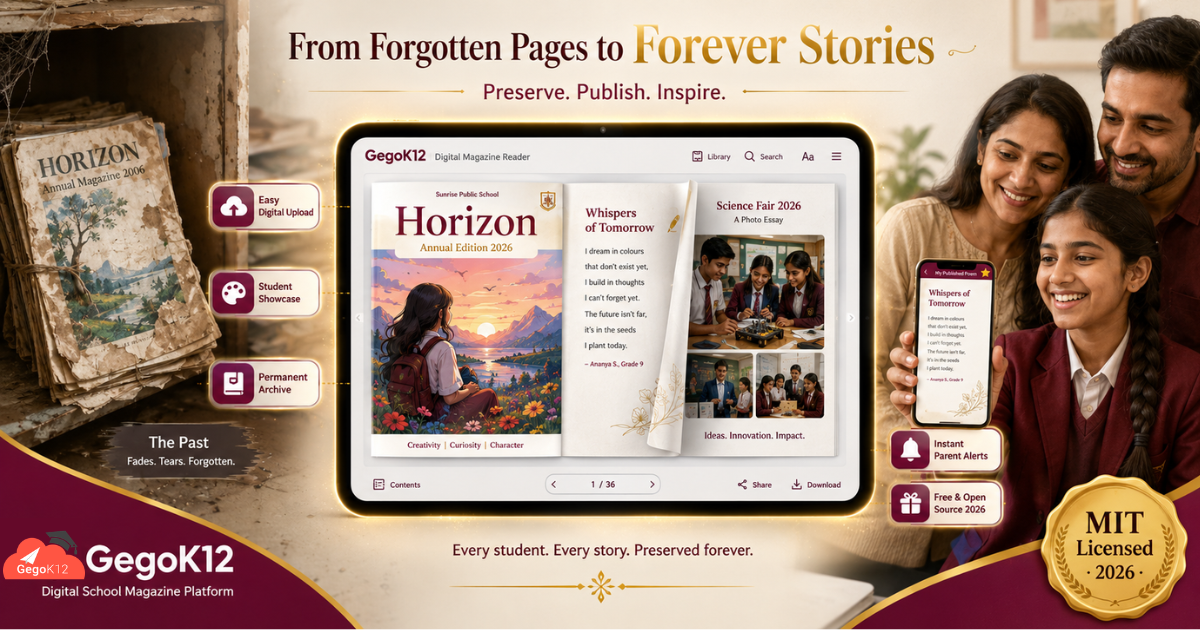
The best free open-source school magazine publishing software in 2026 is GegoK12’s Magazine & Journal Management Module — a 100% free, MIT-licensed digital publishing platform built into the GegoK12 school ERP. Schools use it to upload and publish unlimited magazine editions in multiple formats, organise content by year, issue, or theme, showcase student literary and artistic work, notify parents instantly upon publication, and preserve every edition permanently in a searchable cloud archive — at zero cost, with no printing expenses ever again.
Why This Matters More Than It Seems
Every school has a creative legacy hidden inside its magazine archive — student poems written at thirteen, science essays that hinted at future careers, artwork that captured a moment of adolescent imagination. However, in most Indian schools in 2026, that legacy exists as fragile paper, printed once a year, distributed to a few hundred families, and then slowly lost to time, water damage, and the simple fact that nobody keeps old magazines forever.
Moreover, the cost of producing those fragile, temporary archives is substantial. Annual printing runs for a school magazine commonly cost ₹40,000 to ₹1,50,000 depending on print quality and distribution volume — a significant expense for something that most families misplace within two years.
In 2026, GegoK12’s Magazine & Journal Management Module solves this completely. To show precisely how, this guide follows three real student contributions — a poem, a science essay, and a painting — through the complete digital publishing journey, from the moment of creation to permanent institutional preservation.
GegoK12 is a free and open-source school management platform, with the complete source code available on GitHub under the MIT licence.
Story One: Ananya’s Poem — From Notebook to National Visibility
Ananya, a Class 9 student, writes a poem about her grandmother’s village for her English assignment. Her teacher, recognising something special in the writing, encourages her to submit it for the school’s Annual Day magazine edition.
The Old Way: Ananya’s handwritten poem would be typed by a teacher, proofread once, and placed somewhere in a 60-page printed magazine alongside 80 other student contributions. The magazine prints in March, distributes to students before the summer break, and within a year, most copies are lost, damaged, or forgotten in school bags. Ananya’s grandmother — who inspired the poem — never sees it, because she lives in a village without easy access to the printed copy.
The GegoK12 Way: The English teacher photographs Ananya’s handwritten poem, then types it into the Magazine module’s submission interface — formatting it with the title, author name, class, and a small illustration Ananya drew alongside it. The poem becomes part of the “Literary Corner” category in the upcoming Spring 2026 edition.
When the edition publishes, every parent in the school receives an instant notification: “The Spring 2026 school magazine is now live — read inspiring stories from your school community.” Furthermore, Ananya’s mother takes a screenshot of the poem and sends it via WhatsApp to her own mother in the village — Ananya’s grandmother, who reads about herself in her granddaughter’s words within hours of publication, regardless of geographic distance.
Moreover, the poem remains permanently accessible. Three years later, when Ananya applies for a creative writing scholarship, she retrieves the published poem from the school’s digital archive — complete with the original publication date and edition reference — as a verifiable, professionally presented portfolio piece.
Story Two: Rohan’s Science Essay — From Classroom Project to Lasting Recognition
Rohan, a Class 11 student, writes a detailed essay on sustainable agriculture practices for a science journal contribution. His essay includes data tables, a hand-drawn diagram, and references to local farming practices he researched personally.
The Old Way: The science department selects the best three essays from 40 submissions for the printed journal. Most submissions, including potentially strong ones, never reach any audience beyond the teacher who graded them. The selected essays appear in a black-and-white printed booklet with limited visual quality — Rohan’s carefully drawn diagram loses clarity in the low-resolution print reproduction.
The GegoK12 Way: The science department head reviews all 40 submissions through the Magazine module’s upload interface — where multiple staff members collaboratively review contributions before selection. Rohan’s essay is selected, and his diagram uploads as a high-resolution image, preserving every detail exactly as he drew it.
The essay publishes in the “Science Journal” category — a section the school maintains continuously across the academic year rather than confining science writing to a single annual edition. Consequently, strong submissions get published as they arrive, rather than being held back for months awaiting a single printed deadline.
Furthermore, when a university admissions officer reviewing Rohan’s application later asks about his demonstrated interest in agricultural science, Rohan shares the digital magazine link directly — a professionally presented, permanently accessible piece of evidence that a printed booklet from three years ago would likely never have survived to provide.
Story Three: The Art Exhibition That Outlived the Exhibition
The school’s annual art exhibition features paintings, sketches, and craft projects from students across Classes 3 to 12. Historically, the exhibition runs for three days, after which the physical artworks are returned to students and the visual record exists only in a handful of photographs taken by parents on their phones — scattered, unorganised, and never compiled into a coherent collection.
The Old Way: A printed magazine occasionally includes a small black-and-white photograph section featuring a few selected artworks — perhaps eight or ten pieces out of 150 displayed. The vast majority of student artistic effort, regardless of quality, receives no permanent documentation at all.
The GegoK12 Way: The art teacher photographs every displayed artwork using a school tablet during the exhibition. That evening, she uploads the complete collection — all 150 pieces, organised by class and theme — into a dedicated “Art Exhibition 2026” edition within the Magazine module. Each piece carries the student’s name, class, and a short description of their inspiration.
Within 24 hours of the exhibition closing, every student who contributed an artwork has a permanent, professionally presented digital record of their work — accessible to their parents, grandparents, and eventually their own children decades later. Furthermore, the school’s complete visual creative history — rather than a curated fragment of it — exists in one searchable, organised archive.
Moreover, three students whose artwork received particular recognition in the digital edition go on to pursue art-related extracurricular paths — partly inspired by seeing their work formally published and celebrated alongside their peers’ contributions, rather than disappearing the moment the exhibition tables were cleared.
What Changes When Every Story Gets This Treatment
These three stories illustrate a pattern that repeats across every contribution a school publishes through GegoK12’s Magazine module. Specifically, four structural shifts occur:
From Scarcity to Abundance — printed magazines historically limit content because page count drives cost. Consequently, schools select only the “best” few contributions, leaving most student creative work unpublished. GegoK12 removes this constraint entirely — unlimited digital editions mean every worthy contribution finds a home.
From Annual to Continuous — rather than waiting for a single yearly printing deadline, schools publish editions whenever sufficient content accumulates — monthly, termly, or event-triggered. As a result, student work reaches an audience while the achievement is still fresh and meaningful.
From Fragile to Permanent — paper degrades, gets lost, and disappears from institutional memory within years. Digital editions in GegoK12’s cloud archive remain accessible indefinitely — searchable by student name, year, category, or keyword, decades into the future.
From Local to Universal Access — a printed magazine reaches only the families who receive a physical copy and keep it. A digital edition reaches every parent through instant notification, every grandparent through a shared link, and every future scholarship committee or university admissions officer the student chooses to share it with.
Complete Feature Breakdown: GegoK12 Magazine & Journal Module
Multi-Format Digital Uploads
Teachers and administrators upload content in PDF, image, or document format — accommodating typed essays, scanned handwritten work, photographed artwork, and professionally designed layouts equally well.
Custom Categories and Organisation
Schools organise published content by academic year, edition number, theme, or subject category — “Literary Corner,” “Science Journal,” “Art Gallery,” “Sports Chronicle” — creating a structured, navigable archive rather than an undifferentiated content dump.
Cover Page Design and Branding
Each edition carries a custom cover page, giving the digital magazine the visual presentation quality of a professionally printed publication — reinforcing the school’s brand identity and creative standards.
Unlimited Access for the School Community
Parents, students, and staff access every published edition at any time through the parent app or web portal — with no distribution logistics, no printing run limitations, and no risk of a family simply never receiving their copy.
Instant Parent Notification on Publication
The moment a new edition publishes, GegoK12 sends an automatic notification to every parent through the integrated SMS / Push Notification system — ensuring no proud family misses their child’s published work.
Permanent Archival Preservation
Every edition published through GegoK12 remains in the system indefinitely — building a multi-year, searchable institutional creative archive that grows richer with every academic year rather than disappearing into storage boxes.
Student Participation and Recognition
By dramatically lowering the barrier to publication — no page limits, no single annual deadline — GegoK12 enables significantly more students to see their work formally published, strengthening engagement and creative confidence school-wide.
How the Magazine Module Connects to the Free GegoK12 Ecosystem
| Module | Connection to Magazine Publishing |
|---|---|
| Student Information Management | Contributor details auto-populate from verified student profiles |
| Classroom Management | Submissions organised and attributed by class and section automatically |
| SMS / Push Notifications | Parents receive instant alerts the moment a new edition publishes |
| Calendar, Event & Gallery | Magazine launch dates and submission deadlines appear on the school calendar |
| Library Management | Published editions complement the library’s broader reading culture initiatives |
| Lesson Plan | Language and art teachers integrate magazine contribution into curriculum planning |
| Reception Module | Visiting alumni and prospective families view the magazine archive at the front desk |
| Facilities Management | Art exhibition and event documentation supports the school’s broader campus showcase |
| Attendance Management | Student participation records complement academic and extracurricular profiles |
| Leave & Payroll Management | Staff time previously spent on print production redirected toward editorial quality |
Who Benefits Most in 2026?
Language and Art Teachers gain a publishing platform that removes the scarcity constraint of printed pages — encouraging broader student participation and more frequent recognition of creative work throughout the year, rather than once annually.
School Principals eliminate a recurring printing expense of ₹40,000 to ₹1,50,000 annually while simultaneously improving the reach, permanence, and presentation quality of student creative work.
Parents receive instant notification when their child’s work publishes — and can share it with extended family regardless of geographic distance, something a single printed copy circulating within the immediate household could never achieve.
Students experience meaningfully higher odds of seeing their work formally published, building creative confidence and providing genuine portfolio material for future academic and scholarship applications.
Alumni Relations Officers access decades of preserved school creative history — valuable content for alumni engagement, school anniversary celebrations, and institutional storytelling.
IT Teams and Developers work with the fully open-source codebase on GitHub — extending the module with features like reader analytics, comment sections, or integration with the school’s public website.
Getting Started: Launch Your First Digital Edition in 2026
Step 1 — Deploy the platform. Fork or download the GegoK12 GitHub repository. MIT licensed — free to self-host with no recurring costs.
Step 2 — Read the publishing guide. The official GegoK12 documentation covers magazine module configuration — category setup, cover page design, contributor permissions, and notification settings.
Step 3 — Watch the tutorial. The GegoK12 YouTube tutorial playlist includes a complete magazine publishing walkthrough — from content upload to edition launch.
Step 4 — Book a free demo. Schedule a free demo session with the GegoK12 team. Watch a sample edition upload, publish, and trigger parent notifications in real time.
Step 5 — Collect your first submissions. Announce an open submission window to students. Within weeks, you will have enough content for your school’s first fully digital, permanently archived magazine edition.
Frequently Asked Questions
Q: What is the best free school magazine publishing software in 2026?
GegoK12’s Magazine & Journal Management Module is the leading free, open-source option in 2026. It supports unlimited digital editions, multi-format uploads, custom categorisation, instant parent notifications, and permanent cloud archival — at zero licensing cost.
Q: Can parents download the published magazine?
Direct downloading is currently restricted to protect student privacy and maintain system efficiency. However, parents access and revisit every edition anytime through the parent app or web portal.
Q: How long does it take to publish a new edition?
Uploading and publishing a new edition typically takes minutes using GegoK12’s cloud-based interface — a dramatic reduction from the weeks required for traditional print production.
Q: Are past editions preserved permanently?
Yes. Every published edition remains in GegoK12’s archive indefinitely, searchable by year, category, or keyword — building a permanent institutional creative history.
Q: Is this module really free?
Yes. The Magazine & Journal module is part of GegoK12’s free, open-source core platform, released under the MIT licence with no printing costs, subscription fees, or publishing charges.
Every Student’s Creative Voice Deserves to Last Longer Than a Printed Page
In 2026, the question is no longer whether schools should celebrate student creativity — every school already tries to. The real question is whether that celebration survives. GegoK12’s Magazine & Journal Management Module ensures it does — permanently, accessibly, and at zero cost.
Publish Your School’s First Digital Edition Today
| What You Need | Where to Go |
|---|---|
| 📂 Free open-source code | GegoK12 on GitHub |
| 📖 Publishing setup guide | Official Documentation |
| 🎥 Magazine module tutorial | GegoK12 YouTube Playlist |
| 🖥️ Full free school ERP | Free Open Source School ERP |
| 🎓 Live publishing demo | Book Your Free Demo Session |
Related Free GegoK12 Modules
- Student Information Management — contributor profiles linked automatically to every published submission
- Classroom Management — class-organised contributions for structured, attributable publishing
- SMS / Push Notifications — instant alerts the moment a new edition goes live
- Calendar, Event & Gallery — magazine launches and submission windows scheduled on the unified calendar
- Library Management — complementary reading culture initiatives supported alongside digital publishing
- Lesson Plan — curriculum-integrated creative writing and art assignments feed the magazine pipeline
- Reception Module — front desk showcase of the school’s creative archive for visiting families
- Facilities Management — exhibition and event documentation preserved alongside campus management records
- Attendance Management — participation in creative activities complements the complete student profile
- Leave & Payroll Management — staff time redirected from print production toward editorial and creative mentorship