
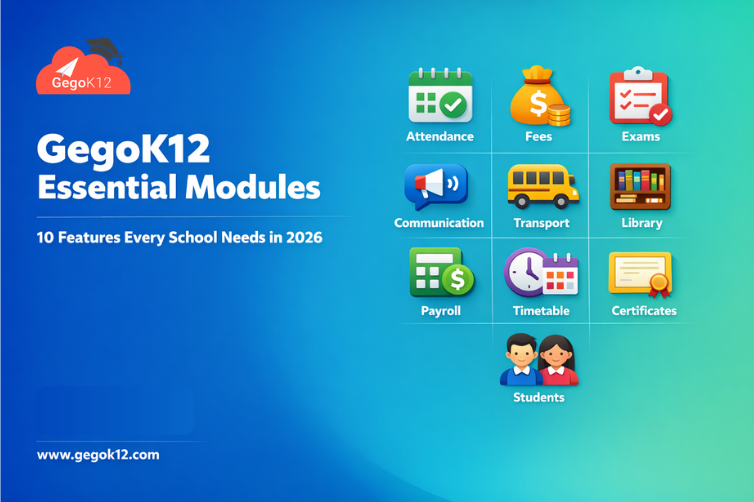
GegoK12’s modular architecture delivers comprehensive school management through specialized features addressing every operational dimension. From automated attendance saving 3,100 hours annually to intelligent fee management eliminating collection delays, from exam scheduling streamlining assessment periods to real-time parent communication transforming engagement – GegoK12’s essential modules provide the foundation for efficient, modern school administration. Understanding each module’s capabilities, benefits, and implementation strategies helps schools maximize value from this free open-source platform while avoiding deployment mistakes that undermine potential efficiency gains.
Unlike monolithic commercial systems forcing schools to purchase comprehensive packages including unused features, GegoK12’s modular design lets institutions deploy only needed functionality. Small schools might implement attendance, fees, and basic communication while large districts activate complete suites spanning academics, HR, finance, operations, and stakeholder engagement. This flexibility combined with zero licensing costs positions GegoK12 as ideal solution for schools of all sizes seeking modern management without commercial software expenses.
1. Attendance Management Module
Core Functionality: Digital attendance tracking replaces time-consuming paper registers with instant marking via mobile apps, biometric devices, RFID cards, or QR code scanning. Teachers mark attendance in seconds rather than 5-10 minutes per class period. Real-time synchronization updates central databases immediately, providing administrators instant visibility into daily attendance patterns without waiting for manual register transcription.
Key Benefits: Schools with 500 students save over 3,100 hours annually – equivalent to 1.5 full-time positions—just by eliminating manual roll calls. Automated parent notifications alert families within minutes when students miss classes, improving safety and enabling immediate follow-up about absences. Comprehensive analytics identify chronic absenteeism patterns weeks before traditional monitoring would notice problems, enabling early interventions preventing dropouts.
Implementation Tips: Start with simple mobile app marking before deploying sophisticated biometric or RFID systems. Train teachers thoroughly on mobile interfaces ensuring smooth adoption. Configure automated parent notification settings carefully – instant SMS alerts for absences, daily summary emails for tardiness patterns. Integrate attendance with student information system ensuring enrollment changes automatically update attendance rosters.
ROI Metrics: Beyond time savings, improved attendance detection directly impacts funding—many jurisdictions base per-pupil allocations on attendance rather than enrollment. Schools reducing chronic absenteeism by even 5% through better monitoring recover substantial revenue while improving outcomes.
2. Fee Management System
Core Functionality: Comprehensive financial module handles complex fee structures—tuition, transport, activities, materials, uniforms—with flexible payment options including installments, sibling discounts, scholarships, need-based adjustments, and late payment fines. Online payment integration supports credit cards, debit cards, digital wallets, and bank transfers. Automated receipt generation, ledger maintenance, and financial reporting provide accountants complete transparency without manual spreadsheet management.
Key Benefits: Eliminates cash handling security risks and accounting errors. Automated payment reminders reduce collection delays—families receive SMS or email notifications before due dates and escalating reminders for overdue balances. Online payment convenience improves on-time payment rates while reducing office workload handling physical cash and check deposits. Comprehensive financial dashboards show collection rates, outstanding balances, and cash flow patterns informing better financial planning.
Implementation Tips: Configure fee structures carefully before academic year starts—changing mid-year creates confusion. Set up payment gateway integrations with popular options like Razorpay, PayU, or Stripe for Indian schools, Stripe or Square for international institutions. Define discount and scholarship rules clearly ensuring automated calculations match intended policies. Train accounting staff thoroughly on reconciliation processes matching online payments with bank deposits.
ROI Metrics: Reduced collection delays improve cash flow—schools report 15-25% faster payment collection with automated reminders versus manual processes. Elimination of cash handling reduces theft risks while freeing office staff from time-consuming counting and bank deposit trips.
3. Exam Scheduling and Result Generation
Core Functionality: Coordinates complete examination lifecycle from schedule creation through result distribution. Administrators create exam calendars assigning dates, times, and rooms while avoiding conflicts. Automated admit card generation produces hall tickets for all students. Teachers enter marks through web or mobile interfaces. System automatically calculates totals, averages, grades, and ranks based on predefined formulas. Digital report card generation formats results professionally with school branding. Distribution happens electronically via parent portals and email rather than printed cards requiring manual distribution.
Key Benefits: Eliminates weeks of manual scheduling work creating conflict-free exam calendars. Teachers save 10+ hours per term through automated grade calculation and report card generation rather than manual compilation and formatting. Instant result publication means families access grades immediately rather than waiting days or weeks for printed report cards. Digital archives maintain complete historical records without physical storage consuming office space.
Implementation Tips: Define grading rules, calculation formulas, and report card templates before first exam cycle—changing formats mid-year creates confusion. Train teachers on mark entry interfaces ensuring accuracy and completeness. Configure security settings carefully ensuring only authorized teachers can modify grades. Test report card generation thoroughly with sample data before actual result publishing preventing embarrassing formatting errors distributed to all families.
ROI Metrics: Teacher time savings translate directly to instructional capacity—hours previously spent on administrative grade compilation redirect toward teaching or student support. Faster result distribution improves parent satisfaction while enabling quicker interventions for struggling students identified through timely grade visibility.
4. Parent Communication Module
Core Functionality: Multi-channel communication platform enabling announcements, notices, event information, individual messages, and emergency alerts through SMS, email, push notifications, and in-app messaging. Bulk messaging reaches all families simultaneously while targeted communications send information to specific groups—grade levels, sections, activity participants. Two-way messaging enables parents to ask questions and receive responses from teachers or administrators. Read receipts confirm message delivery and viewing.
Key Benefits: Eliminates paper notices children inevitably lose in backpacks—digital communications reach families reliably. Instant emergency notifications enable rapid response during urgent situations. Reduced office workload answering repetitive parent questions through automated FAQ resources and chatbots. Improved family engagement through consistent information flow building trust and partnership between schools and homes.
Implementation Tips: Collect accurate parent contact information during enrollment ensuring phone numbers and email addresses remain current. Configure notification preferences letting families choose preferred communication channels. Create message templates for common announcements reducing composition time. Establish communication policies preventing message overload—excessive notifications train families to ignore important alerts buried in routine updates.
ROI Metrics: Reduced phone call volume frees office staff for higher-value work. Improved parent satisfaction from timely information strengthens school reputation supporting enrollment. Better emergency communication enhances safety while demonstrating school attentiveness to family concerns.
5. Student Information Management
Core Functionality: Centralized database maintaining comprehensive student records—personal demographics, enrollment details, academic history, health information, emergency contacts, family details, disciplinary records, special needs, and custom fields schools define for specific tracking needs. Role-based access ensures teachers see their students, parents access only their children’s information, and administrators maintain oversight while respecting privacy. Data import/export capabilities facilitate integration with external systems and government reporting.
Key Benefits: Single source of truth eliminates scattered spreadsheets and disconnected databases creating data inconsistencies. Comprehensive profiles provide complete student pictures informing better support decisions. Historical records follow students through entire school careers enabling longitudinal analysis impossible with annual data silos. Regulatory compliance simplified through automated report generation extracting required data formatted for government submissions.
Implementation Tips: Audit existing student data before migration identifying duplicates, inconsistencies, and missing information requiring correction. Define data governance policies assigning responsibility for maintaining accuracy. Train staff on proper data entry ensuring quality from the start rather than accumulating errors requiring expensive cleanup. Implement validation rules preventing obviously incorrect entries like future birthdates or invalid email formats.
ROI Metrics: Reduced time searching for student information scattered across multiple sources. Improved decision quality through comprehensive data visibility. Simplified compliance reporting saving hours during government submission deadlines.
6. School Bus Management and GPS Tracking
Core Functionality: Fleet management tracking vehicles, routes, drivers, conductors, and student assignments. GPS integration shows real-time bus locations on maps. Route optimization suggests efficient paths reducing fuel consumption and travel time. Driver behavior monitoring records speeding, harsh braking, and route compliance ensuring safety. Parent visibility through mobile apps shows bus locations and estimated arrival times eliminating anxious waiting at stops.
Key Benefits: Route optimization generates 15-25% fuel savings through efficient path planning and reduced idle time. Real-time tracking enables 80% faster emergency response knowing exact bus locations during incidents. Driver monitoring improves safety—speeding decreases 40%, harsh braking drops 35% when behavior gets tracked. Parent anxiety eliminated through transparent bus location visibility and arrival notifications.
Implementation Tips: Install GPS devices in all buses before route optimization expecting immediate fuel savings funding equipment costs. Train drivers on mobile apps for marking student boarding/alighting and reporting incidents. Configure geofencing alerts notifying administrators when buses deviate from approved routes. Set parent notification preferences balancing useful information with alert fatigue from excessive notifications.
ROI Metrics: Fuel cost savings often exceed GPS system costs within first year. Reduced parent phone calls asking bus whereabouts frees office staff. Improved safety reduces liability risks and insurance premiums.
7. Library Management System
Core Functionality: Digital cataloging of book collections with searchable database letting students and teachers find materials easily. Barcode scanning enables quick checkouts and returns. Automated overdue tracking sends reminders to students with late books. Reservation system lets students request currently borrowed materials. Circulation analytics reveal popular titles and usage patterns informing acquisition decisions.
Key Benefits: Eliminates manual ledgers tracking borrowings prone to errors and loss. Students find relevant resources quickly through digital search rather than browsing physical card catalogs. Automated reminders reduce book loss from forgotten returns. Analytics optimize collection development investing limited budgets in materials students actually want.
Implementation Tips: Catalog existing collections before going live—incomplete databases frustrate users unable to find known materials. Assign ISBN numbers and barcodes systematically. Train librarians thoroughly on all system functions before student access. Create user-friendly search interfaces encouraging independent student discovery rather than requiring librarian mediation for every transaction.
ROI Metrics: Reduced book loss through better tracking. Librarian time savings redirect toward literacy programs and research instruction rather than manual circulation management. Improved collection quality through data-driven acquisition rather than intuition-based purchasing.
8. Leave and Payroll Management
Core Functionality: HR module tracking staff leave balances by type—sick, personal, vacation, professional development. Digital leave request submission and approval workflows replace paper forms. Payroll calculation handles salary structures, allowances, deductions, taxes, and benefits producing detailed payslips. Automated bank transfers distribute salaries punctually. Comprehensive employee records maintain employment histories, qualifications, and performance documentation.
Key Benefits: Automated leave tracking eliminates spreadsheet errors and ensures policy compliance. Staff access accurate leave balances before requesting time off preventing disputes about entitlements. Payroll automation eliminates calculation errors ensuring accurate timely payment. Reduced HR workload processing leave requests and calculating payroll manually.
Implementation Tips: Configure leave policies accurately matching employment contracts and labor regulations. Define payroll formulas carefully including all allowances and deductions before first payroll run. Test calculations thoroughly with sample data before actual salary processing. Implement appropriate security ensuring payroll data remains confidential while providing employees access to their own payslips.
ROI Metrics: Elimination of payroll errors reduces staff complaints and potential legal issues. HR time savings redirect toward recruitment, training, and employee development rather than administrative processing.
9. Automated Timetable Generator
Core Functionality: Intelligent scheduling algorithm creates optimal timetables considering teacher availability, room capacity, subject requirements, and student group assignments. Constraint definition ensures compliance with curriculum requirements, work hour limitations, and pedagogical preferences. Automated generation produces conflict-free schedules in minutes rather than weeks of manual effort. Substitution management handles teacher absences suggesting qualified replacements with available periods.
Key Benefits: Weeks of manual scheduling work eliminated through automated generation. Better balanced teacher workloads through algorithmic optimization rather than ad-hoc manual assignment. Instant schedule modifications handling mid-term changes impossible to manage efficiently with manual processes. Substitute teacher coordination simplified through automated matching of qualifications and availability.
Implementation Tips: Define all constraints clearly before generation—teacher availability, room equipment needs, pedagogical preferences. Start simple with basic constraints, gradually adding complexity as confidence grows. Review generated schedules carefully before publication ensuring algorithm interpretations match intentions. Maintain manual override capability for edge cases requiring human judgment.
ROI Metrics: Administrator time savings equivalent to weeks annually. Improved schedule quality through optimization balancing multiple factors simultaneously beyond human capacity. Greater scheduling flexibility enabling mid-term adjustments previously avoided due to manual revision difficulty.
10. Digital Certificate Generation
Core Functionality: Template-based automated creation of official documents—transfer certificates, character certificates, bonafide letters, exam hall tickets, ID cards, and custom certificates for achievements or participation. Mail merge functionality populates templates with student data from central database. Digital signatures and official seals ensure authenticity. Bulk generation produces hundreds of certificates simultaneously. PDF output enables email distribution or printing on-demand.
Key Benefits: Eliminates manual typing of repetitive information prone to errors. Consistent professional formatting reflects well on institutional image. Instant generation means families receive documents immediately rather than waiting days or weeks for manual preparation. Digital archives maintain complete certificate histories without physical storage consuming office space.
Implementation Tips: Create professional templates matching institutional branding before first use. Test thoroughly with sample data ensuring all merge fields populate correctly. Configure appropriate approval workflows requiring administrator authorization before distribution. Maintain secure digital signature protocols preventing unauthorized certificate generation.
ROI Metrics: Office staff time savings from automated generation rather than manual document preparation. Improved parent satisfaction through instant document availability. Reduced paper and printing costs for certificates distributed digitally.
Conclusion: Maximizing GegoK12 Module Value
GegoK12’s comprehensive module suite addresses every school management dimension through specialized functionality delivering measurable efficiency gains, cost savings, and stakeholder satisfaction improvements. Success requires thoughtful implementation – starting with high-priority modules delivering quick wins, training staff thoroughly, configuring carefully before going live, and continuously optimizing based on real-world usage patterns.
The modular approach means schools needn’t deploy everything simultaneously. Begin with attendance and fees generating immediate value, gradually adding modules as capacity and confidence grow. This phased implementation prevents overwhelming staff and stakeholders with too much change simultaneously while building momentum through visible successes.
Explore GegoK12’s complete module ecosystem at gegok12.com and discover how free open-source school management transforms operations without commercial software expenses.